


 Shashank Shastri
Assigned Topic Scope: This evaluation focuses on outlining and defining key components of project evaluation, its attributes, types, methods, processes, key indicators, and best practices. Understand how to consolidate and analyze project performance data to facilitate the advancement of your career in project management.
What are the most effective evaluation metrics for 2025?
Consider your most recent project. Your team put in dozens of hours over the course of several months. Did you hit the primary project goals? Did you stay within budget? Did stakeholders receive value from the project? Without effective project evaluation, the answer to each of these questions is unknown.
Evaluating the Outcome of Your Project is Not an Afterthought! Understanding and learning project management evaluation techniques is fundamental to moving from an average to a great project manager. Evaluation techniques and methods are crucial in achieving competencies in your Project Management Professional credential training, and more importantly, understanding how to evaluate the success of your project and how your project objectives were satisfied.
What is the Impact of Project Evaluation?
The impact of project evaluation is to provide a system and structure to enable the assessment of a project to determine the project's overall value, goals, and objectives. This evaluation focuses on understanding how data is collected within the project and how data is converted and organised to create an impact within the project objectives.
Most importantly, it focuses on more than just measuring success or failure. The insights evaluation harnesses aids in measuring success, informing accurate choices, improving performance, and fostering accountability. Some of these include performance evaluation through comparison of achieved results and goal(s) set, improvement and learning through recognition of aspects that obstruct progress, accountability and transparency through documentation of results achieved, and informed decision making to assist in effective allocation of limited resources. In project management, understanding project budgeting becomes essential during the process of adjusting the allocation of resources as a result of evaluation.
Types of Project Evaluation
Project evaluation is categorised into several types. Each type of evaluation has its unique focus and is able to provide information at different levels. Knowing what these different types are will aid in determining the most suitable evaluation techniques.
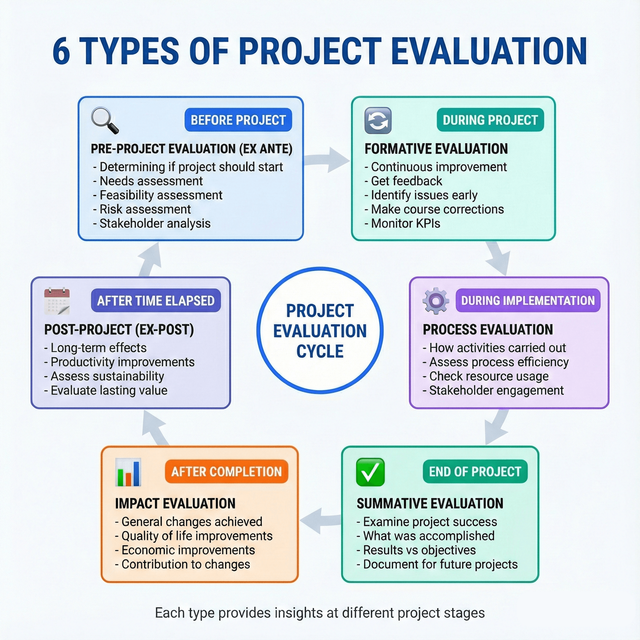
Pre-project evaluation or Ex Ante evaluation
Pre-project evaluation, or Ex Ante evaluation, as it is sometimes known, happens before the project has officially started and focuses on determining whether it is a good idea to start the project, or if the project will be successful. This evaluation involves several parts, namely: needs assessment, feasibility assessment, risk assessment and stakeholder analysis. Knowledge of the different methods of project selection is important to ensure that the right initiatives are evaluated.
As an illustration, a nonprofit planning a community health program would first complete a feasibility study to determine whether the nonprofit should pursue the development by assessing operational and financial feasibility.
Formative Evaluation (During-Project)
Formative evaluation is conducted during the implementation of the project to get feedback that can be used to improve it. This evaluation helps project managers identify potential issues before the project goes too far to make course corrections. For example, a tech firm creating new software might be able to measure that the firm is obtaining user feedback and evaluating it within its project timeline. KPIs for project management become especially important during this phase
Summative Evaluation (End-of-Project)
Summative evaluation is conducted at the end of the project to examine whether the project was successful and what the impacts were. It determines what was accomplished and what was not accomplished, and assesses what the final results were in relation to the objectives. This information is used to document the results for the project and describe the results achieved, so the information can be used in planning future similar projects. This is where the value of having the PMP certification for project management is obvious, as it is the certified project managers who know how to do this type of evaluation at the end of the project.
Process Evaluation
Process evaluation focuses on what took place during the implementation of the project, how the activities were carried out, and whether they were carried out as planned. It determines what was the efficiency of the processes, i.e., their effectiveness, and how resources were used, how the processes engaged the stakeholders, and how the resources were used.
Impact Evaluation
Impact evaluation determines what the general changes were that took place in the targeted groups or their surrounding environment. It assesses the overall changes that were achieved, and the contribution that was made toward such changes, for example, an improvement in a person's quality of life or an economic improvement.
Post-Project Evaluation (Ex-Post)
Post-project evaluation examines the long-term effects of the project on the community after a period of time has elapsed since the project was completed. For example, the evaluation of an ERP system that was implemented 3 years has been completed will measure the improvement in productivity over time.
Project Evaluation Methods
Choosing the appropriate evaluation methods will help you get the best, most accurate, and meaningful values regarding the project.
Qualitative Methods
Qualitative methods involve the collection of non-numeric data to obtain an understanding of a value or process. Some of the common techniques include interviews (in-depth, one-on-one discussions on a subject), focus groups (facilitated discussions to gain a group's perspective), observations (watching certain activities), and case studies (comprehensive studies that focus on one aspect of the phenomenon).
Quantitative Methods
Quantitative methods involve the collection of numerical data, which can then be analysed statistically. Some common techniques include surveys and questionnaires (systematic collection of data), metrics and KPIs (monitoring the budget, timeline), and data analysis (involves the usage of statistically oriented techniques to uncover data).
Mixed Methods
Mixed methods involve the collection of both qualitative and quantitative data. This technique is particularly helpful to answer complex questions that require both numerical data and non-numeric stakeholder experiences. Understanding what the PMP certification is will explain how mixed methods improve one's holistic understanding of the project.
How to Perform Project Evaluation: 7 Essential Steps
There are a number of key steps involved in conducting a project evaluation. These steps are critical for the...
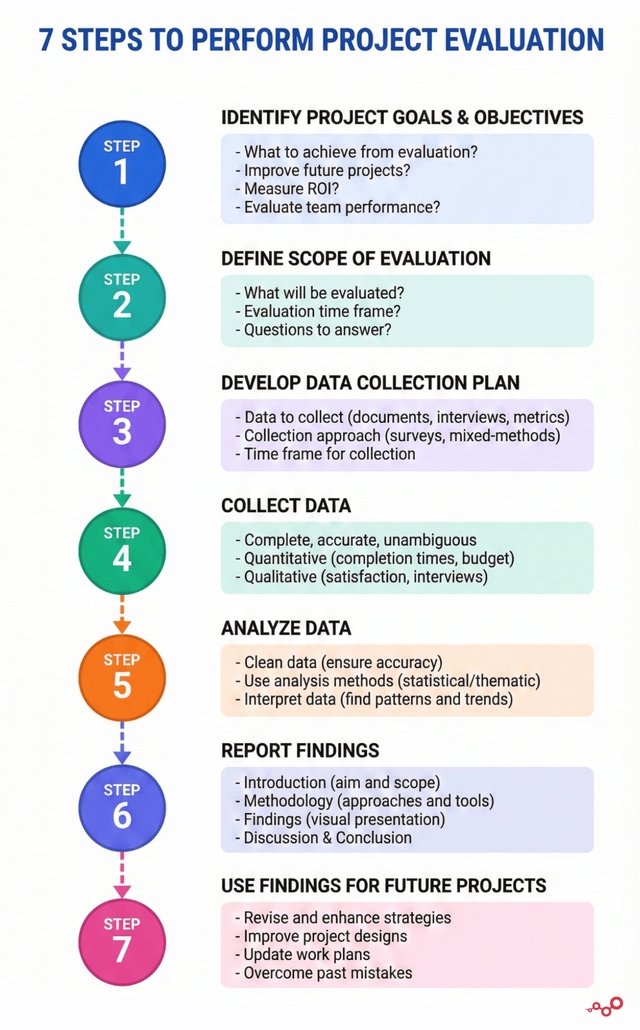
Step 1: Identify Project Goals and Objectives
Establish specific objectives for the evaluation by asking yourself the question, What do you want to achieve, and what value do you want to get from the evaluation. Is it to improve future projects? Measure ROI? Evaluate the performance of the team. Goals that are specific to the project and to the evaluation will help to prioritise what the evaluation should focus on. Looking into the requirements for PMP certification will help you appreciate this step.
Step 2: Define the Scope of Evaluation
Establish what will be evaluated, the evaluation time frame, and the evaluation questions to be answered. Understanding project cycle management will provide the necessary context for defining the evaluation scope.
Step 3: Develop a Data Collection Plan
Specify the evaluation questions, and identify the methods and tools that will be used for the collection of the required information. Identify the data to be collected (e.g., project documents, stakeholder interviews, performance metrics), the collection approach (e.g., survey, interviews, or mixed-methods), and the time frame data will be collected.
Step 4: Collect Data
Collect information meticulously and ethically: Ensure that the data collected is complete, accurate, and unambiguous. Collect both quantitative data (e.g., completion times and budget metrics) and qualitative data (e.g., satisfaction surveys and interview transcripts).
Step 5: Analyze Data
This is the most critical step. Gain actionable insights by cleaning data (ensuring it is accurate), using the required analysis methods (e.g., statistical or thematic) and interpreting the data (finding patterns and trends that align with the project's objectives).
Step 6: Report Findings
Document your work in a comprehensive report that is subdivided into the following sections: Introduction; Aim of the Report, and Scope of the Report; Methodology; Explanation of the Methodological Approaches and Tools Utilized; Findings; Presentation of the Findings in Visual Form; Discussion; Explanation of the Primary Findings and the Areas that Needed Improvement; and the Conclusion; presents the Concrete Proposed Actions to Be Taken in Future Work of the Project.
Step 7: Use Findings for Future Projects.
Use the results of your evaluations to make future projects even better, and then to foster the results obtained. Use the lessons learned to revise and enhance the strategies, project designs, and work plans. Identifying the causes of the project failures through the evaluation is instrumental in overcoming the mistakes.
Conclusion
Understanding how to do evaluation in projects may change the results of the projects and may help in the mobility of your career in the practice of the management of projects. If you apply the appropriate evaluation techniques at each of your project’s milestones [tracking key metrics/ change in budget, compliance to the schedule, satisfaction of the shareholders) You will be able to gain information to use for the iterative process of continuous improvement. Evaluation is more than measuring the success of the project and or the failures. It is the process of learning and information evaluation to make decisions that help your organisation and its stakeholders. You will develop your practice of project management.

Shashank Shastri is a PMP trainer with over 14 years of experience and co-founder of Oven Story. He is an inspiring product leader who is a master in product strategies and digital innovation. Shashank has guided many aspirants preparing for the PMP examination thereby assisting them to achieve their PMP certification. For leisure, he writes short stories and is currently working on a feature-film script, Migraine.
Questions people ask
Published