


What is a Project Director? Duties, Functions, and Career Path for 2025
Defined Topic Scope: This extensive guide analyzes the project director role thoroughly, including the main duties, required competencies, how one can climb through the ranks, anticipate earnings, and the steps to become a project director in 2025.
If you have been pondering who is above project managers in the hierarchy chart, allow me to introduce you to a project director. This is not a senior designation that one would find on the span of control chart. A project director is, in essence, a tactical leader who is responsible for the supervision of many projects, or in some cases, whole portfolios, to ensure that they meet the overarching objectives of the entity. While project managers are concerned with the delivery of single projects on time and within budget, project directors are concerned with their goals.
The road to the title of project director is long, and will require significant experience and a very deep and bold strategy, and one will need to exhibit high levels of and strong skills in leading others. If you have the intention of getting further in the hierarchy of project management, undertaking a PMP certification training is a great way to fast-track that career progression. This certification is proof of your ability to manage complex projects and will lead you towards other top-tier management positions.
What is a Project Director?
A project director is a unique role that combines strategy and leadership. It is similar to how project managers manage their staff and tactical workflows to accomplish a specific project. While a project manager is responsible for his or her team and a specific project, a project director is responsible for an entire program or a set of related projects. As a project director, one is expected to operate at a higher level and is responsible for the overall outcome of several projects or programs at the same time. He or she is expected to manage higher-level outcomes and allocate resources at an optimised level for the project.
In most cases, project directors report to the COO, Head of Strategy, or senior management teams. Project Directors are present in almost every industry: construction, IT, etc. In all these industries, they provide leadership to tactically manage and mitigate risks, control costs, and ensure that every construction work package starts and finishes on time. Learning about project management can help provide clarity on how project directors exist in the larger project management system.
 Free Blueprint
The PMP Exam Clearance Blueprint
The 5-step plan recent first-attempt passers followed domain weightages, score-report targets and the week-before routine.
Project Director vs. Project Manager: Key Differences
I will provide some clarity on these two related roles: while project director and project manager on the surface may look like they do the same jobs, the scope of their focus and strategic impact is where the main difference lies.
- Define the professional relationships held with others in the table, broken down by attributes.
- What do project directors do? What functions do they perform? What actions do they perform? What do they know?
- What do project directors do? What functions do they perform? What actions do they perform? What do they know?
 Free Template
A day-by-day study schedule built around your exam date
What do project directors do?
Key Strategic Actions:
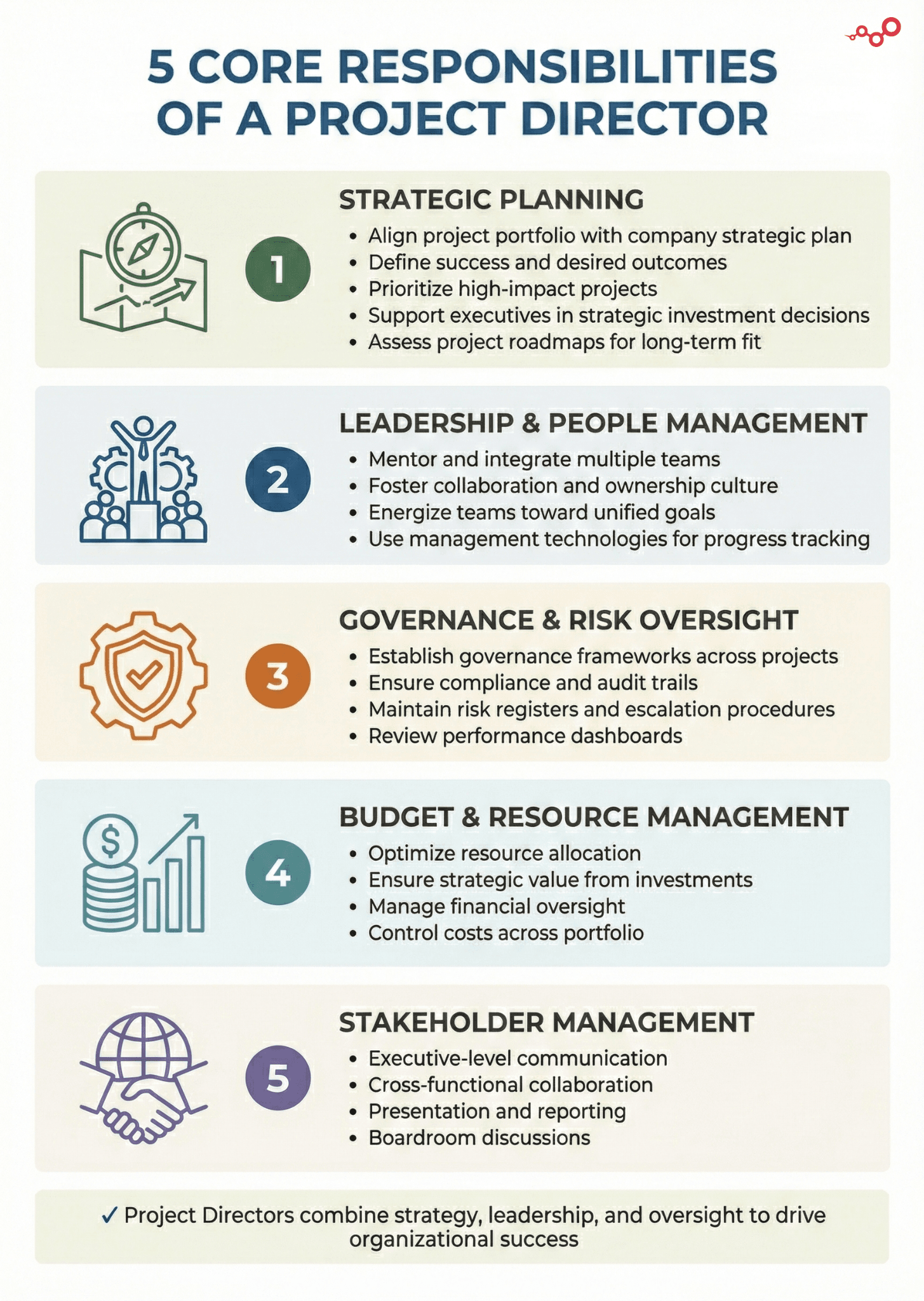
- Reconcile the project portfolio with the company's strategic plan and targets for growth.
- Identify success and the desired customer and business outcomes.
- Optimise and concentrate on the projects with the greatest impact and implement the ones most feasible.
- Support executives in their strategic investment options.
- Assess the project roadmaps to ensure long-term strategic fit across the portfolio.
Leadership and People Management
Project managers report to project directors and are responsible for energising, mentoring, and integrating the efforts of several teams to work toward a unified goal. Their leadership culture of the project ecosystem determines the level of collaboration, ownership, and outcomes. High-performing project directors use management technologies to keep and control progress, the flow of work, and status dashboards. This differentiating skill, project leadership, is the key to the success of project directors.
Governance and Risk Oversight
The core of every project director's role is governance and risk oversight. It is the project directors' role to guarantee, for every project undertaken, uniformity in the governance frameworks and governance compliance, and to ensure visibility of the risks before they materialise. Understanding the different types of project risk enables project directors to better manage project risks.
| Zone | Role of Project Director |
| Governance Structures | Constructs the governance structure of multiple projects |
| Compliance | Assesses audit trails and progress reports |
| Risk Management | Implements and maintains risk registers and escalation procedures |
| Performance Oversight | Reviews data on dashboards and takes action if necessary |
Budget Management and Resource Assignment
62% of outsourced IT projects are over budget, and miscommunications account for 56% of failures. Budget and resource management is one of the most important functions of a project director. They make sure that every dollar, every hour, and every skill that is spent brings the most strategic value. This is necessary to fully understand budgeting in project management. It gives the financial education necessary to base resource allocation on.
Fundamental Competencies for Project Directors
For one to be a project director, there is a specific combination of technical knowledge, strategic thinking, and people skills that is ideal.
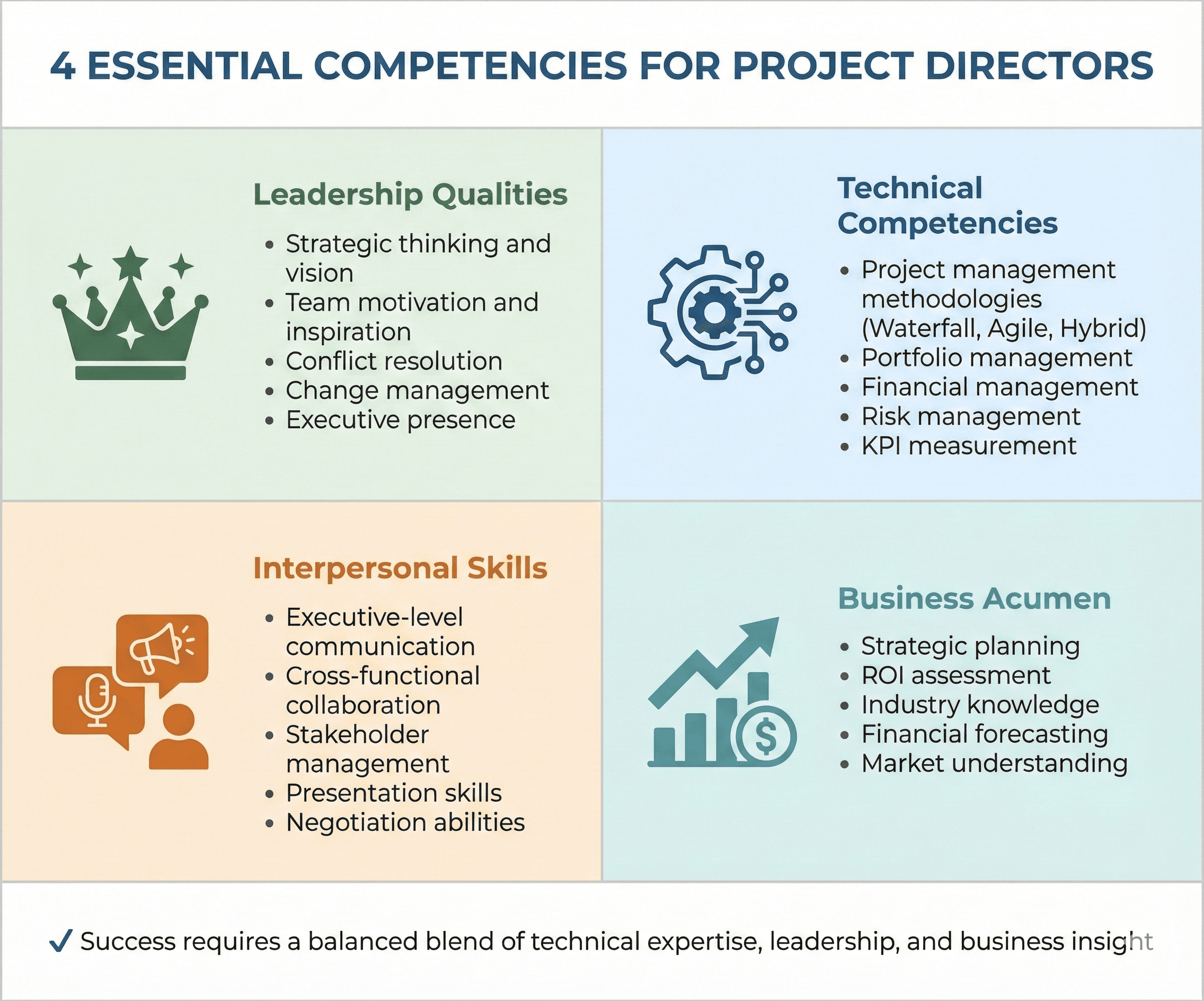
- Leadership Qualities: Excellent project directors must possess strategic thinking and vision to motivate and lead teams, and succeed in boardroom discussions. They excel in conflict resolution and change management and possess strong executive presence.
- Technical Competencies: Familiarity with major project management methodologies (Waterfall, Agile, Hybrid) is fundamental. An understanding of portfolio management, basic financial management, and risk management is also necessary for a complete technical toolkit. Mastering the KPIs of a project is also necessary to gauge success.
- Interpersonal Skills: Communication at the executive level is what differentiates good directors from the great ones. Cross-functional collaboration, stakeholder management, and presentation skills are necessary.
- Business Acumen: Understanding strategic planning, assessing ROI, and knowing how different industries work and interconnect allows project directors to make informed decisions.
Career Path to Becoming a Project Director
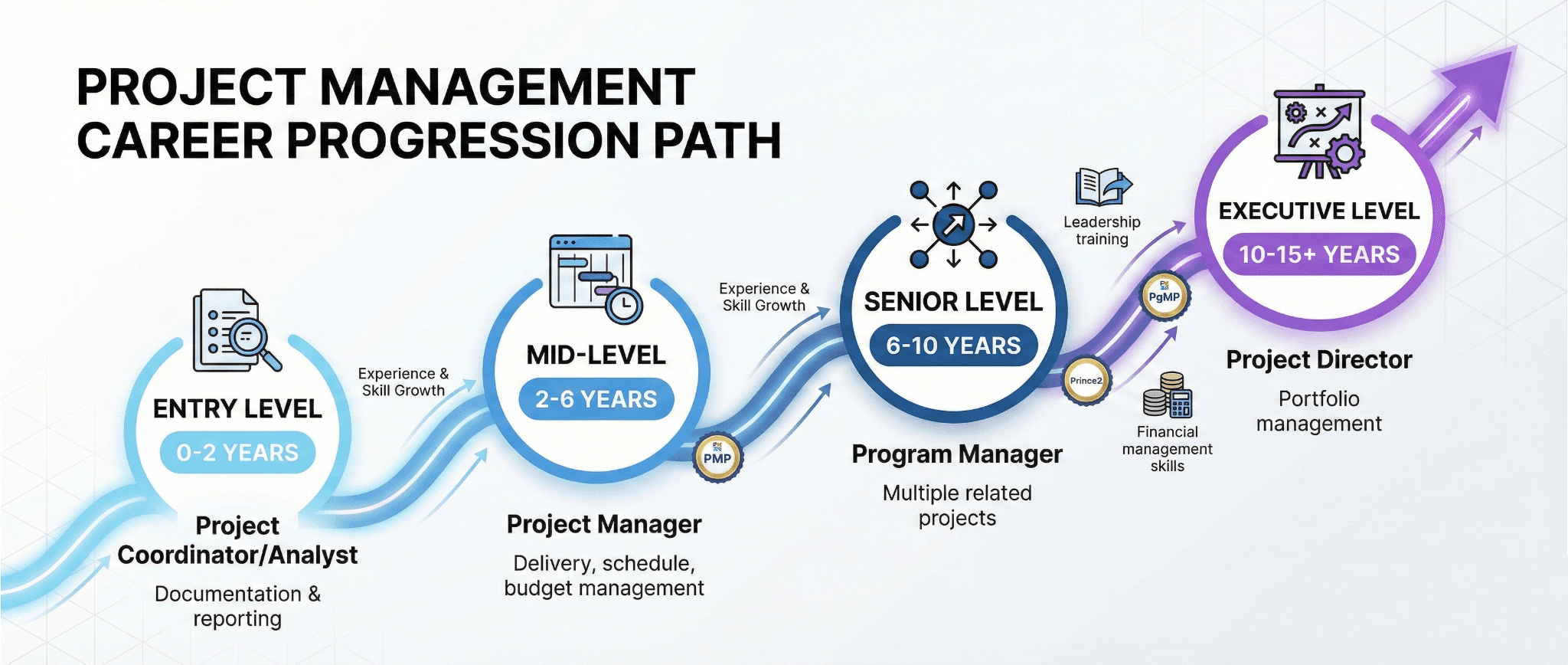
The estimated time to complete the journey to a project director is about 10 to 15 years.
At Entry Level (0-2 Years), you will begin as a Project Coordinator or a Project Analyst, where you will handle documentation, reporting, and administrative assistance.
At mid-level (2-6 years), you will become a Project Manager, where you will handle the delivery, schedule, and budget, and then you will gain the ability to work on advanced roles. During this time, learning about the requirements to gain a PMP certification would be beneficial.
Senior Level (6-10 Years), you will become a Program Manager, where you will be responsible for multiple related projects. Gaining a Techademy PMP certification course would be helpful to gain more credentials.
Executive Level (10-15+ Years) leads to the position of Project Director, where you will run multiple programs or manage an entire portfolio

Not sure PMP is the right move?
Get a free 15-min career consult. An advisor calls you no pitch, just a plan.
Industry Breakdown of Salary:
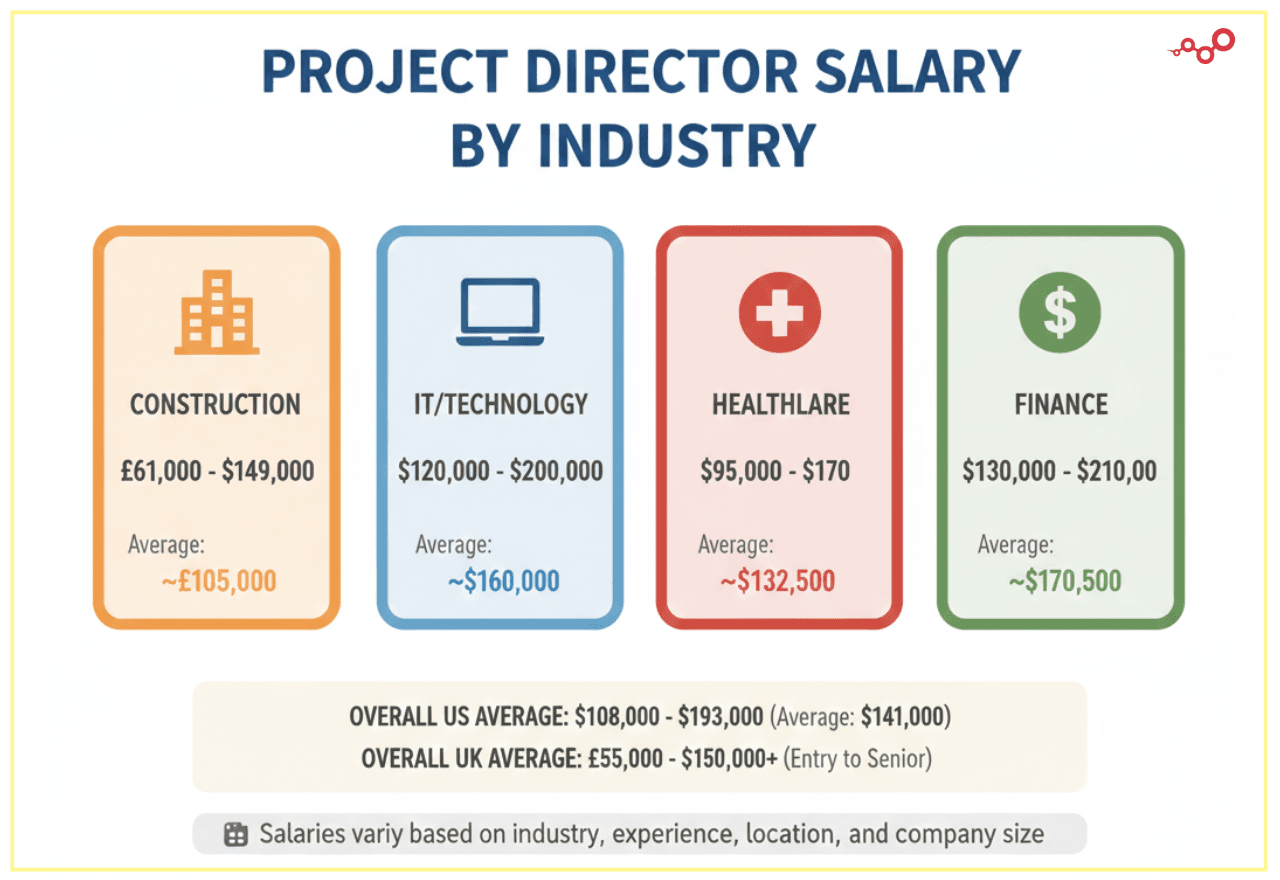
Construction: £61,000 to £149,000
IT/Technology: $120,000 to $200,000
Healthcare: $95,000 to $170,000
Finance: $130,000 to $210,000
Evaluating salary benchmarks for project managers helps to shape practical goals during your journey to the top of the hierarchy (director level, in this case).
Project Director: A Roadmap:
Step 1: Solidify your foundations. Learn scope, time, cost, and quality management. Build your reputation as someone who can deliver under pressure without breaking a sweat.
Step 2: Manage more complicated Programs. Start to control a collection of related interprojects. Enhance your capability to synchronise disparate teams and adjust to the proper balance of tasks. Learning Project Cycle management can offer the needed structure for managing.
Step 3: Strategic training. You will need leadership training as well as organizational strategy and portfolio management. You will need a mindset revolution as you move from 'managing delivery to the goal' to 'leading from the strategy.'
Step 4: Financial understanding Learn cash flow, ROI, and budget forecasting. This is what separates operational managers from strategic leaders.
Step 5: Build executive presence. You should be able to communicate your strategy as you inspire people. This should be done in a way that helps you to win the boardroom during conversations.
Conclusion
The role of project director is the very top of the career mountain in the field of project management. It is the superordinate position wherein, in addition to managing multiple projects simultaneously, one is able to integrate the projects with the long-term objectives and drive measurable, positive outcomes. This level of accomplishment takes many years of experience, continual self-education, and high levels of tuned leadership.
Should you earnestly desire to attain this level, you should start to build the foundation right away. This means you should start honing your project management skills. Obtain the appropriate certifications, and start seeking out opportunities to manage more and more challenging and complex programs. It is important to keep in mind that with each increase in complexity of programs, you will need to conduct more self-education and more leadership. It is a journey.


 35,787 Enrolled
 36 hrs
