


Types of Projects Explained: Complete PM Classification Guide in 2025
Within the discipline of project management, this guide seeks to cover the different types of projects. Through scoping, this guide primarily focuses on the classification based on industry, purpose, organizational structure, and life cycle. Recognizing the different types of projects and mastering suitable management methods, as well as best practices, facilitates successful project completion.
The practical knowledge of the different types of projects is critical in determining the success of the project. For instance, when the project type is known, the project management methodology to be applied becomes easier to identify as well as the resources to be allocated and the parameters of the project. This becomes all the more important when professional certifications such as PMP certification training are in play because recognizing project classification is pivotal, especially for learners exploring the Best PMP course Techademy.
What is a Project?
A project entails the planning and execution of a series of activities in a coordinated manner to achieve a particular objective within a specified start and end. Projects are different from normal day-to-day activities because of their temporary nature, well-defined objectives and distinct outputs, such as developing software, building structures, managing organizational activities, or implementing a marketing strategy. Projects have specified deadlines and budgets benefits of project management.
 Free Blueprint
The PMP Exam Clearance Blueprint
The 5-step plan recent first-attempt passers followed domain weightages, score-report targets and the week-before routine.
Why Classifying Project Types Matters
Grasping various levels of project types enables organizations to pair initiatives with strategic objectives. By defining projects within a specific nature, scope, and aim, management can effectively streamline resource allocation and sequence actions. Different endeavours draw upon varying resource pools in financing, staffing, time, and technical capabilities. Understanding what project types are helps to guarantee that the pertinent resources are used in accordance with the particular demands. Understanding the advantages of project management methods positively impacts performance.
 Free Template
A day-by-day study schedule built around your exam date
Project Types Based on Scope and Size
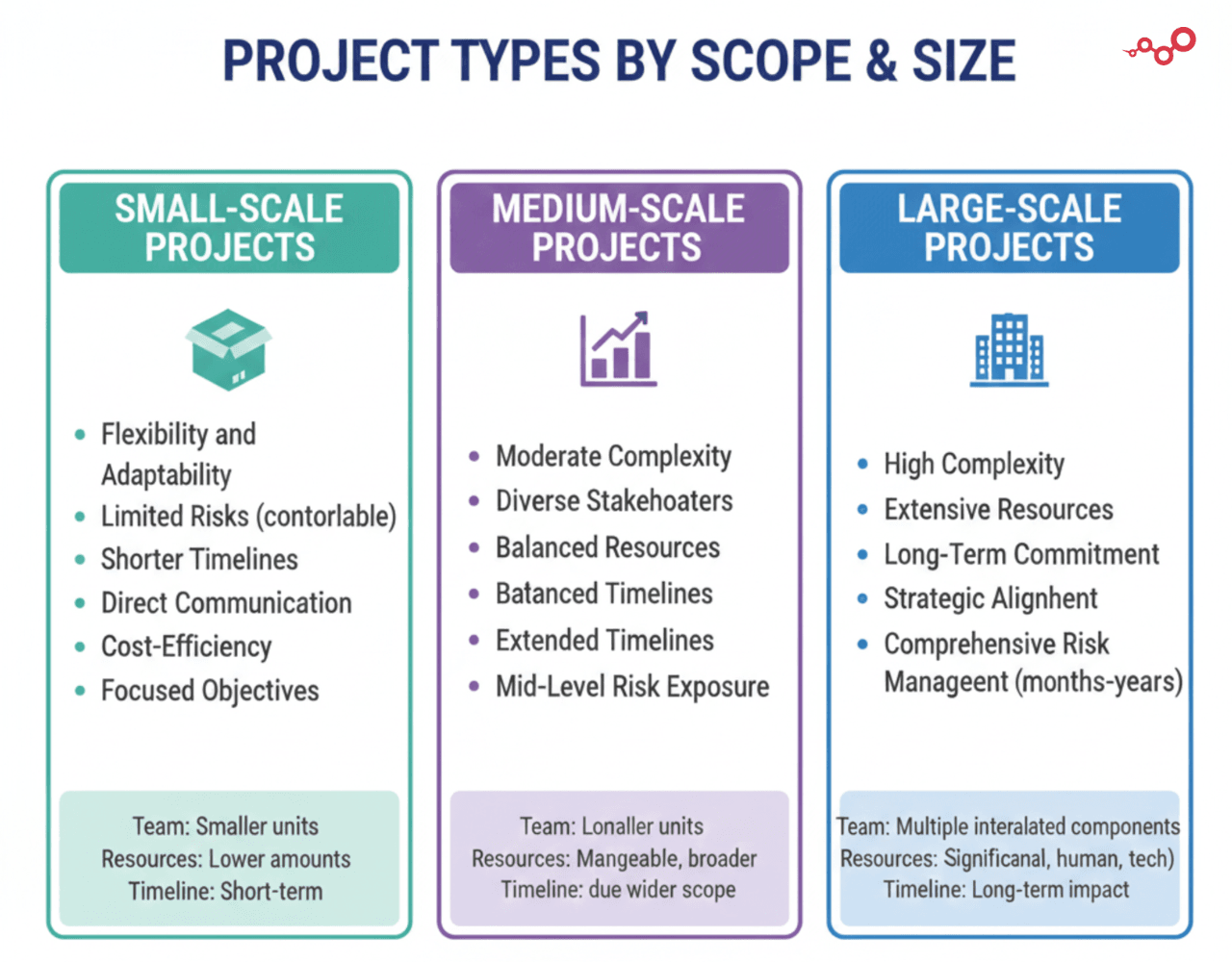
Small-Scale Projects
Small-scale projects are characterized by a narrower scope and lower amounts of resources. They are tackled by smaller unit teams and are governed within a defined time bracket with short-term objectives.
Key Features:
- Flexibility and Adaptability: Enhanced latitude for rapid decision making
- Limited Risks: More controllable and feasible risks
- Shorter Timelines: Faster attainment of set objectives
- Direct Communication: Seamless inter-team communication
- Cost-Efficiency: More affordable than larger projects
- Focused Objectives: Clearly defined objectives
Medium Scale Projects
Medium-scale projects involve a broader scope to a greater degree than small-scale, but less than large-scale. They demand more resources, time, and concerted efforts of larger teams across multiple departments.
Key Characteristics:
- Moderate Complexity: Average demand for planning.
- Diverse Stakeholders: Require communication across a broader range.
- Balanced Resources: Manageable, but larger than small-scale.
- Extended Timelines: Longer owing to wider scope of the project.
- Mid-Level Risk Exposure: More varied types of project risk that require detailed management.
Large-Scale Projects
Large-scale projects are of considerable scope. They require considerable resources. Such projects are, by nature, quite a number of complex interrelated components and have a considerable impact on that organization/community.
Key Characteristics:
- High Complexity: More than one interrelated component of the project.
- Extensive Resources: Significant financial, human and technological resources required for the project.
- Long Term Commitment: Spans over a few months to years.
- Strategic Alignment: Should be aligned to the goals of the organization for the long term.
- Comprehensive Risk Management: Very necessary due to the impact of the project.
Types of Projects Based on Industry or Sector
IT and Software Development Projects
IT and Software projects are iterative due to the constant need for adapting to evolving technology and require a considerable understanding of technology as well as recourse to collaborative development of version control systems and agile methodology.
Examples are mobile app development, enterprise software implementation, website redesign, cloud migration and cybersecurity initiatives.
Construction Projects
Construction projects have distinct phases of the project lifecycle, namely: planning, design, procurement, construction, and maintenance. Throughout the lifecycle of the project, building codes, safety standards, regulatory requirements, and compliance with requirements are important.
Examples: Construction of residential buildings, development of commercial complexes, infrastructure construction, and construction of industrial facilities.
Healthcare Projects
Projects in the healthcare field must comply with healthcare regulations that govern patient safety, confidentiality, and quality. This requires integrating multiple healthcare professionals with the need for strong collaborative relationships. Grasping the intricacies of project management becomes essential for the oversight of these complicated undertakings, which often rely on a clear project management plan.
These include the introduction of electronic health records, the expansion of hospitals, and the initiation of health research and public health education.
Strategic vs Operational vs Compliance Projects
Consider the three broad categorizations for these types of projects.
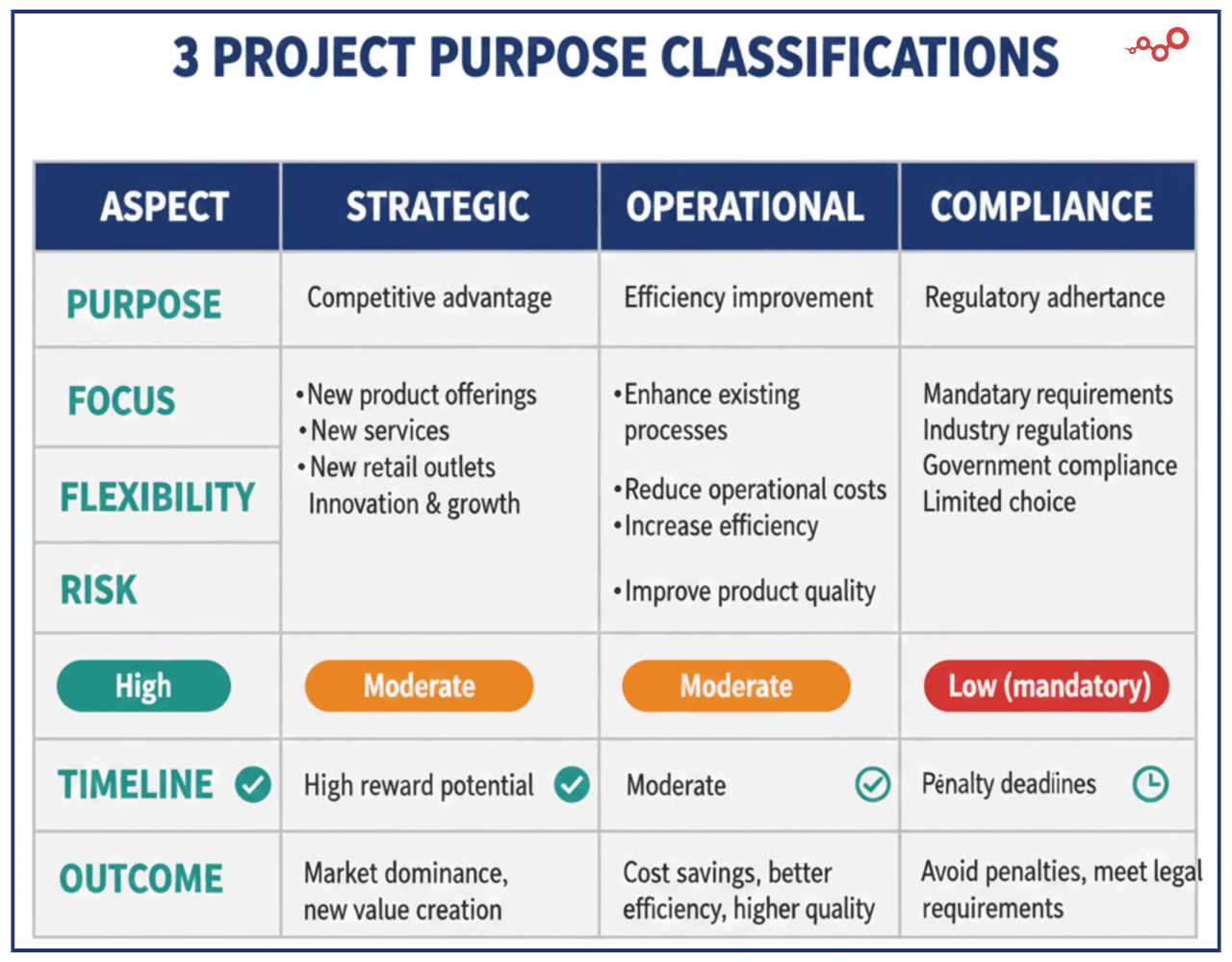
Strategic involves the development of new and innovative offerings. This could be new product offerings, new services, new retail outlets, branches, or factories that a competitor could easily dominate. Knowledge of PMP certification training enables professionals to adopt a strategy.
Operational Projects focus on the enhancement of existing processes. These improvements, while perhaps small, may result in a radical decrease in operational costs, or a notable increase in efficiency, or an augmentation of the quality of the end product. Higher quality products achieve greater market satisfaction.
Compliance Projects focus on mandatory requirements of an industry and/or government regulation. Often, there is limited choice in the projects designed to meet regulations, but there are usually multiple projects that could be undertaken.
Comparison Table: Project Purpose Classification
| Aspect | Strategic | Operational | Compliance |
| Purpose | Competitive advantage | Efficiency improvement | Regulatory adherence |
| Flexibility | High | Moderate | Low (mandatory) |
| Risk | High reward potential | Moderate | Penalty avoidance |
| Timeline | Flexible | Flexible | Fixed deadlines |

Not sure PMP is the right move?
Get a free 15-min career consult. An advisor calls you no pitch, just a plan.
Types of Projects Based on Organizational Structure
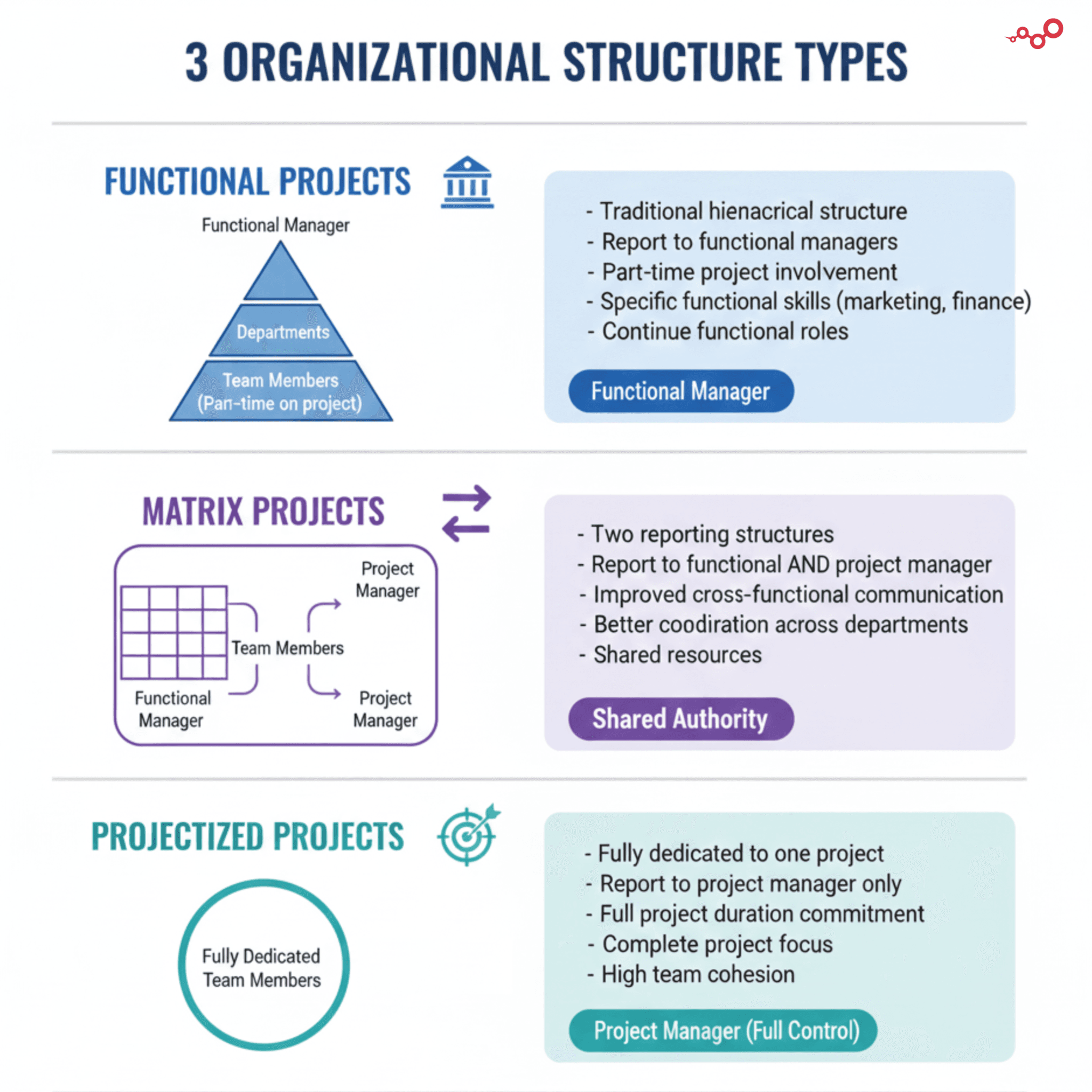
Functional Projects
In functional projects, teams continue to operate under their traditional hierarchical structures, with employees reporting to their functional managers. Teammates within the group possess specific skills from one of the functional areas, such as marketing or finance. Employees continue to carry out their functional roles on the project part-time.
Matrix Projects
Matrix projects employ two reporting structures so that employees report to both a functional manager and a project manager. This allows for improved communication and coordination across functions. Resources and learning on project leadership become crucial for efficient navigation of matrix structures.
Projectized Projects
In projectized organizations, teams are fully dedicated to one project for its whole duration. Project managers have full control and authority over their teams, who are entirely devoted to the project in order to maintain a high level of focus on the project goals. These project selection methods are important to help understand which structures are most appropriate.
Life Cycle Approach to Projects
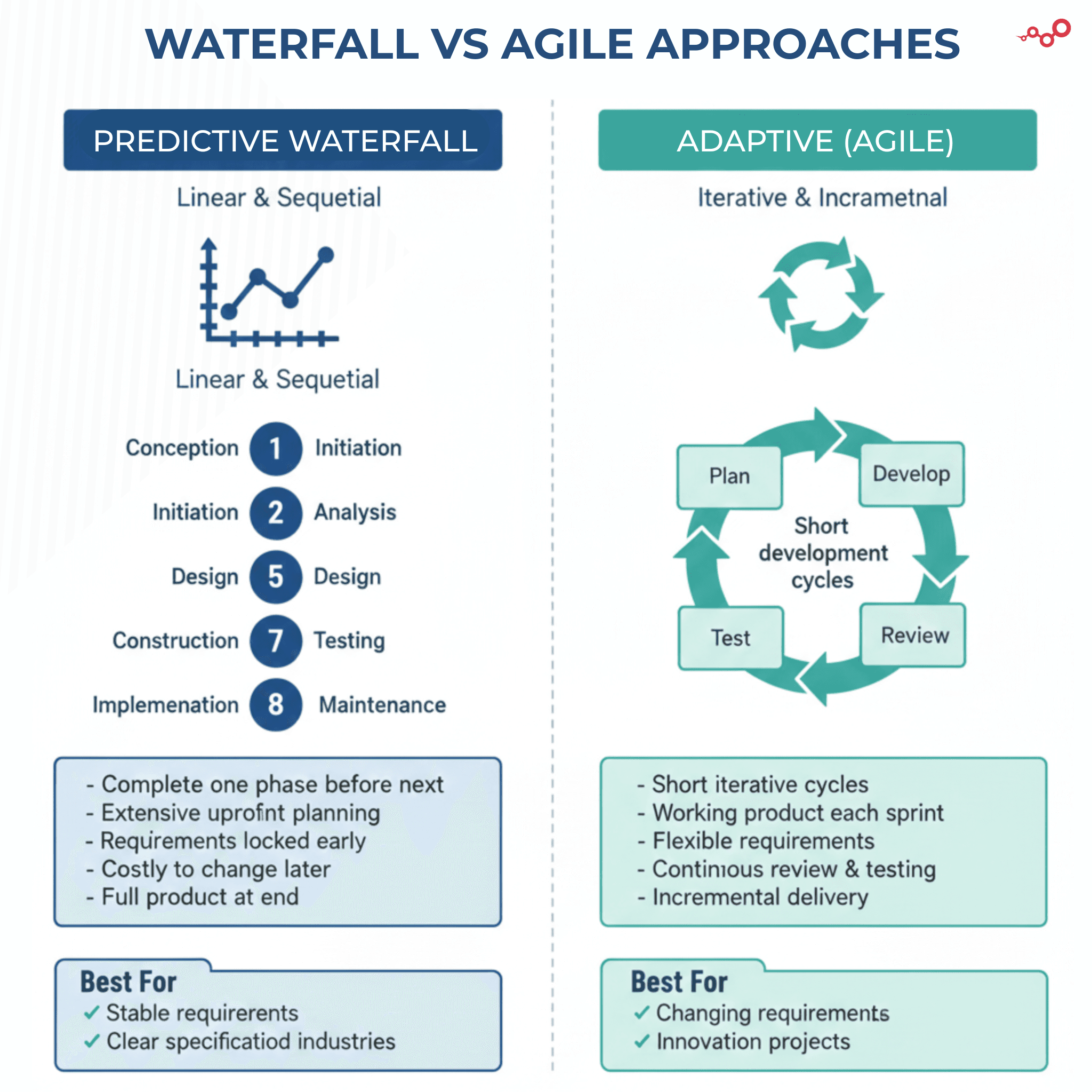
Predictive or Waterfall
This methodology is linear, and to complete one part, you have to finish the previous one completely. In this case, it is conception, initiation, analysis, design, construction, testing, implementation, and maintenance. Waterfall requires extensive planning on the front end and gets to the point where the requisites have to be locked before moving to the next phase. The further along you get and the more progress you have, the more costly it will be to change said requisites.
Adaptive or Agile
Agile is a term for iterative management techniques. The main difference from Waterfall is that, instead of waiting to finish the entire project to present it, there is the use of short development cycles, and one of the objectives is to complete a working product. At each iterative phase, the work and the product are reviewed and tested, aligning with principles of project cycle management.
Choosing the Right Approach to Project Management
In order to choose the right approach, there are several criteria that need to be figured out first. The main characteristics that need to be identified are project characteristics which are size, complexity, clarity of requirements, and how urgent the timeline is. Also, there are the characteristics of the company, which are the culture, experience of the project team, the industry, and the compliance requirements. Understanding budgeting in project management helps allocate resources appropriately.


 35,787 Enrolled
 36 hrs
