


Prove Talent Readiness, Not Participation
 AuthorShrinivas Karthik
 Published23 Jan 2026
 Views40
 Read time4 mins


Executive summary
Enterprise L&D has made steady progress in scale, access, and participation. As business expectations evolve, leaders are now asking a more precise question: are people ready to perform in critical roles. Dashboards built around activity and completion are not designed to answer that question clearly. Recent industry research points to a growing emphasis on demonstrable readiness, observable capability, and business-aligned evidence. This reflects an evolution of the L&D mandate rather than a critique of existing approaches. When readiness is made visible, leaders can make better decisions on deployment, succession, and risk with greater confidence.
Your dashboards are not answering the CEO’s question
Most learning dashboards are built to show scale and participation. They track enrollments, completions, and satisfaction because those signals are reliable, comparable, and easy to aggregate. For many years, this visibility supported important workforce decisions.
What has changed is the nature of executive decision-making. CEOs and business leaders increasingly need to understand whether critical roles are ready to execute, especially as work becomes more complex and execution windows shorten. Deloitte’s 2025 Global Human Capital Trends highlights a persistent experience gap, where workforce preparedness is not keeping pace with evolving role demands, reinforcing the need for readiness insight beyond training activity.
This shift builds on existing dashboards rather than invalidating them. It highlights a gap between participation metrics and readiness insight, and it creates an opportunity for L&D to extend how value is demonstrated.
Readiness is observable if you design for it
Readiness can feel intangible when it is not explicitly designed into learning programs. When learning stops at knowledge transfer, readiness must be inferred through proxies. When learning includes application, readiness becomes visible through behavior and output.
Training Industry notes that leadership and capability measurement is increasingly focused on operational indicators and outcomes that reflect real work.
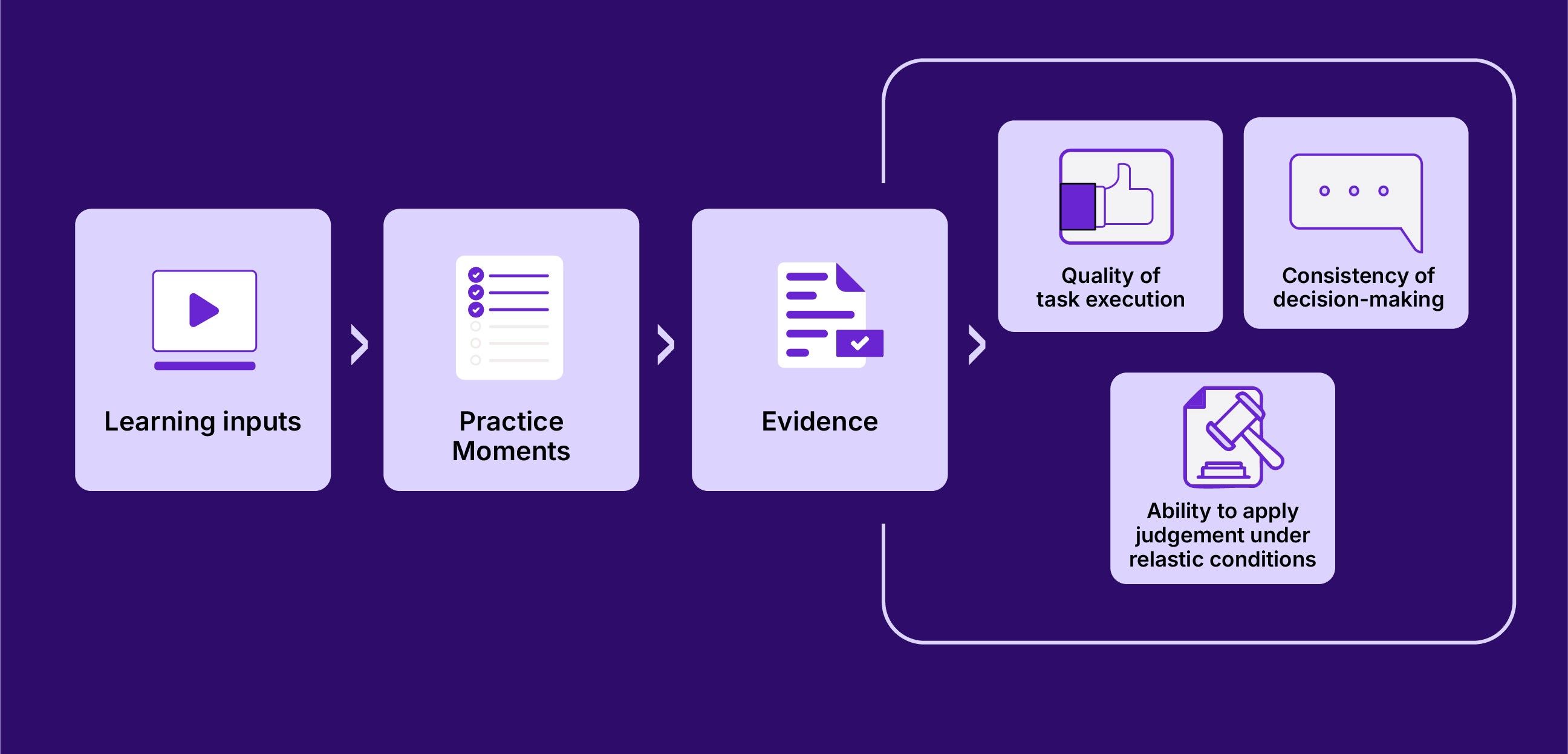
Observable readiness shows up in concrete ways, such as the quality of task execution, consistency of decision-making, and ability to apply judgment under realistic conditions. These signals vary by role, but they are consistently visible when learning journeys intentionally create moments of application.
Turn role tasks into evidence
One of the most effective ways to surface readiness is to anchor evidence in role-specific tasks. Instead of asking whether someone completed a program, the question becomes whether they can perform a task that matters in their role.
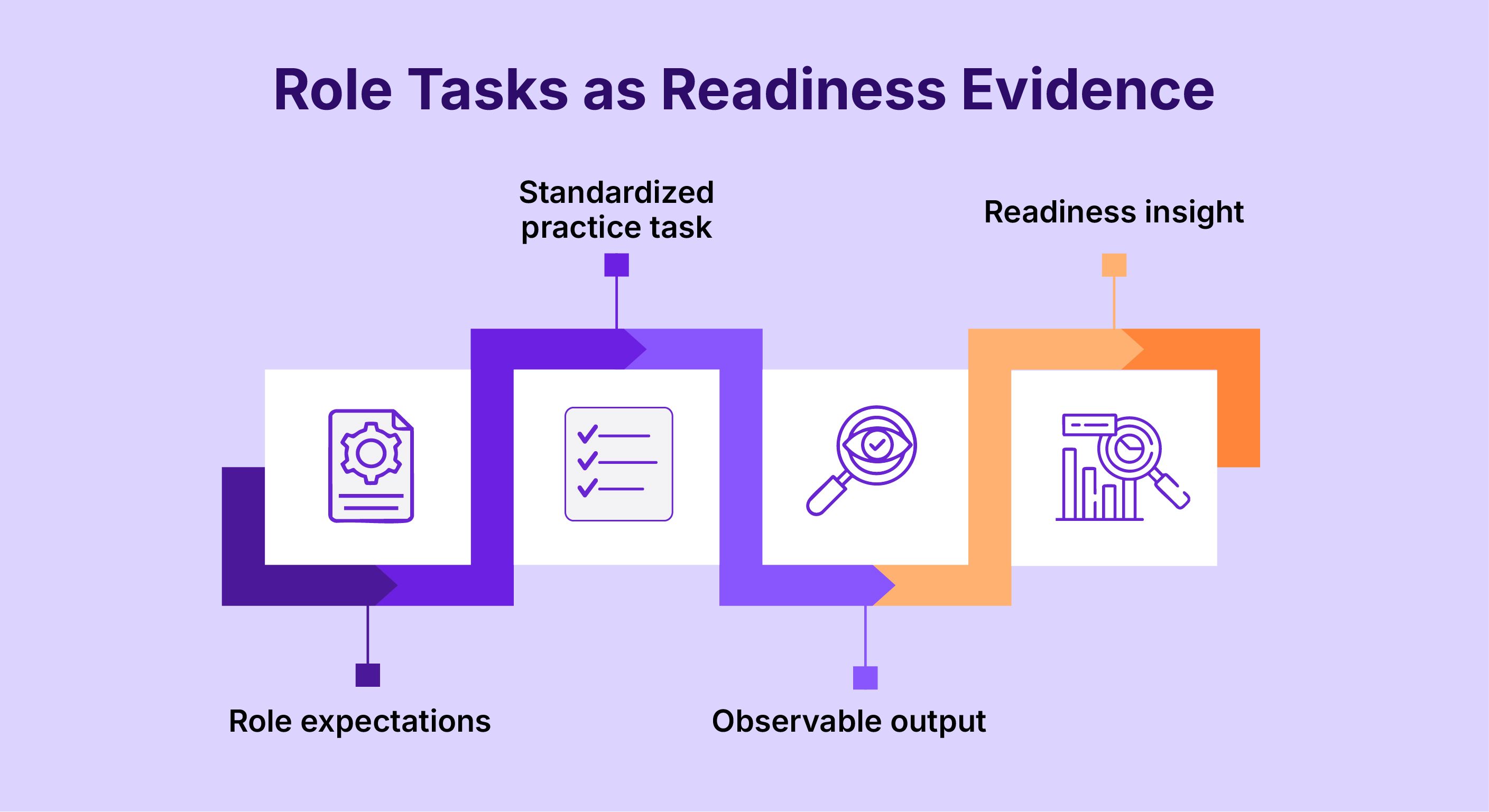
Deloitte’s research emphasizes moving beyond static role definitions toward evidence of experience and capability demonstrated through work, particularly as roles evolve faster than formal job architectures.
Example scenario: A service delivery lead completes a structured incident response simulation aligned to current operating procedures. The output is reviewed against predefined criteria and used to identify readiness gaps.
By standardizing tasks at the role level, L&D can generate consistent evidence while allowing contextual variation across functions and levels. Evidence becomes a natural outcome of practice, not an additional layer of testing.
Managers become your measurement partners
Managers already observe performance as part of their day-to-day responsibilities. The opportunity for L&D is to make those observations more structured and consistent, without increasing administrative burden.
Deloitte’s research shows that closing the experience gap requires tighter integration of learning with daily work, positioning managers as enablers of capability development rather than additional evaluators.
When L&D provides clear criteria and simple observation cues, managers can contribute meaningful signals with minimal effort. Structure reduces friction and supports shared ownership of readiness outcomes.
Connect learning signals to performance signals
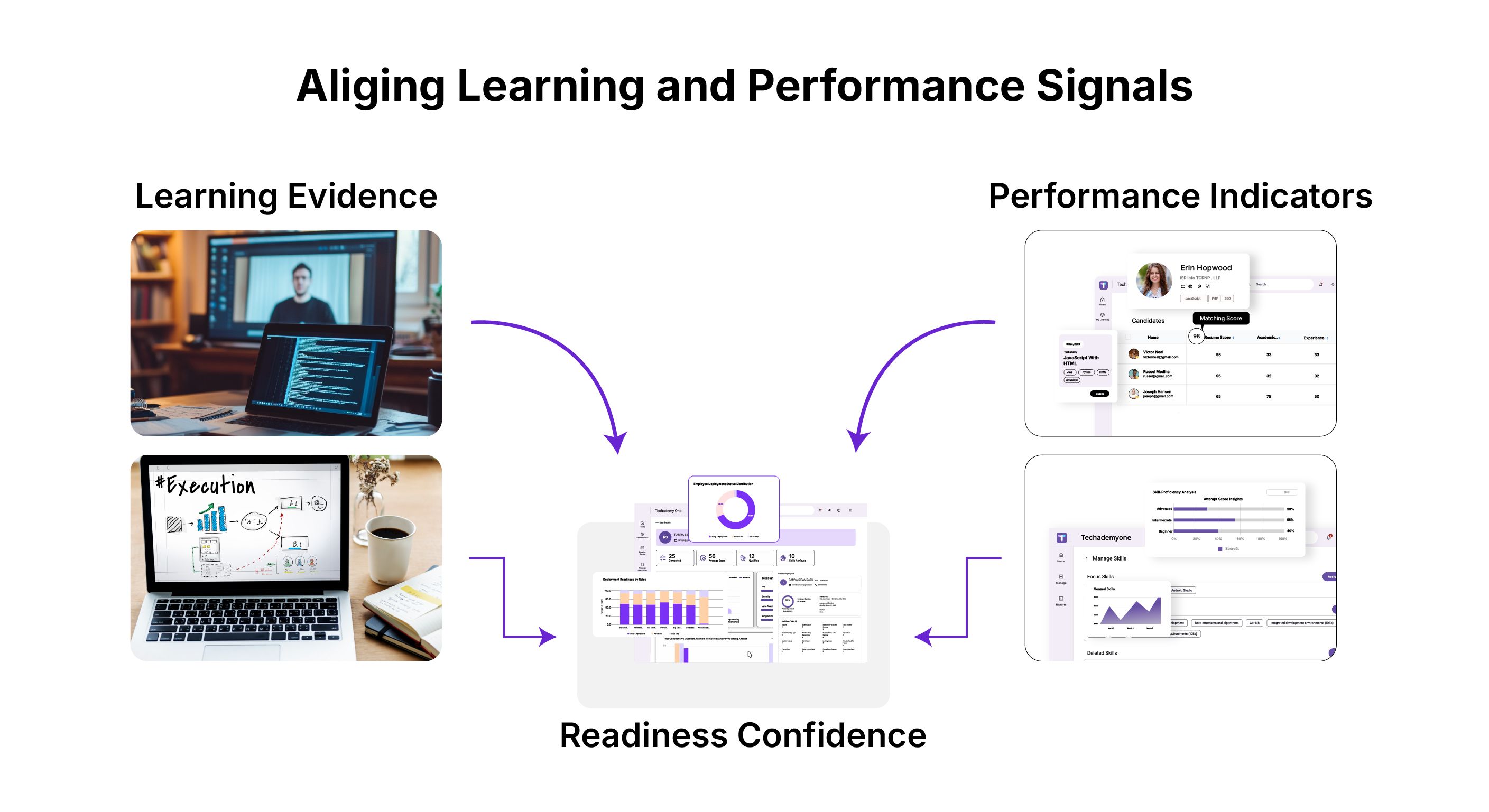
Readiness evidence gains credibility when it aligns with performance indicators the business already tracks. Training Industry points out that learning measurement is shifting toward outcome-oriented signals rather than isolated activity metrics.
This alignment does not imply direct causality. It creates coherence. When learning evidence and performance indicators move in the same direction, leaders gain confidence in workforce readiness and talent decisions.
Show early wins without gaming the metrics
Early wins help build trust when they are credible and focused. The LinkedIn Workplace Learning Report 2025 highlights that while employees value learning, time and workload constraints require learning strategies to align tightly with real work and outcomes.
The goal is not to inflate readiness scores, but to increase confidence in decision-making. Carefully scoped pilots in high-impact roles allow organizations to validate readiness signals while maintaining governance and auditability.
A practical playbook for proving readiness
Start by identifying roles where readiness has the highest business impact. Design one or two role-aligned practice tasks that reflect real work. Define what observable output looks like and how it will be reviewed.
Engage managers with clear guidance on what to observe and when. Aggregate signals at the role or team level to ensure consistency and governance. Review insights with business leaders and refine design based on feedback.
This approach keeps readiness measurement disciplined, scalable, and enterprise-safe.
Five takeaways for enterprise L&D leaders:
- Readiness expectations are evolving alongside business complexity.
- Observable evidence emerges when practice is intentionally designed.
- Role-based tasks provide credible and scalable readiness signals.
- Structured manager involvement strengthens measurement without added burden.
- Alignment with performance indicators builds leadership confidence.
What to do next
As leaders seek clearer visibility into readiness, learning systems must evolve accordingly. Techademy’s Learning Experience Platform supports role-based practice design, captures observable evidence, and translates learning signals into readiness insight without disrupting work.
Explore how Techademy helps enterprises make readiness visible and actionable.
Sources
Deloitte – Closing the Experience Gap Through Talent Development (2025 Global Human Capital Trends)
Training Industry – The Hidden KPI in Leadership Development
LinkedIn Learning – Workplace Learning Report 2025
 Author
Shrinivas Karthik
Chief Product Officer 124 Articles Published
124 Articles Published
Shrinivas Karthik is a seasoned EdTech and product leader with deep expertise in digital learning architecture, learning experience design, and e‑learning strategy. As Chief Product Officer at Techademy, he drives the vision and execution of scalable, outcome‑centric learning solutions that align technology, pedagogy, and business value. With a strong focus on innovative product development and user engagement, Shrinivas partners with cross‑functional teams to enhance learning outcomes, improve adoption, and deliver impact across diverse enterprise environments. Known for blending strategic insight with practical execution, he plays a key role in shaping modern learning ecosystems that support enterprise capability building and digital transformation.
Share