


Micro-Skills Beat Microlearning in Enterprise L&D
 AuthorSameer Desai
  Published03 Feb 2026
 Views85
 Read time4 mins


Executive summary
Microlearning is no longer a format choice. It is an operating decision. As work accelerates and roles change faster than training cycles, enterprises are discovering that shrinking content does not reduce time-to-competency. Industry analysis heading into 2026 reframes microlearning away from “bite-sized content” toward task-level, practice-led micro-skills. This shift matters because capability gaps now translate directly into execution risk, delivery delays, and inconsistent quality. L&D teams that continue to optimize for content velocity will struggle to prove readiness. Those that redesign microlearning as a capability system can give leaders confidence in deployment decisions.
Microlearning Is Everywhere and Still Failing
Most enterprises believe they have already adopted microlearning. Short videos, modular courses, and segmented libraries are now standard across corporate learning environments. Yet many organizations continue to face the same questions from business leaders. Why do errors persist after training? Why does ramp-up still take months? Why do managers hesitate to deploy people into critical work despite high completion rates?
The issue is not learner effort or content access. It is structural. Microlearning has often been implemented as a content efficiency tactic rather than a capability strategy. Shorter assets were expected to solve time pressure and attention constraints on their own. They did not. eLearning Industry notes that microlearning has reached a maturity point where these limitations are now visible. When microlearning is treated as “small content,” organizations experience fragmented skills, weak transfer to work, and little evidence of readiness in real roles.
What Actually Changes in 2026
Looking toward 2026, the conversation is no longer about whether microlearning works. It is about what microlearning is supposed to produce. According to eLearning Industry, the defining shift is a move away from content units toward capability units. Microlearning is repositioned as a delivery architecture aligned to real tasks, decisions, and outputs rather than a collection of short assets.
Three changes stand out in this reframing.
- First, learning activation moves closer to the moment of work. Microlearning is expected to support execution while tasks are being performed, not only before work begins. This shifts design from curriculum planning to workflow mapping.
- Second, practice becomes mandatory. Explanation without action is no longer sufficient. Each micro-unit must include a defined practice step that reflects real working conditions.
- Third, evidence replaces completion as the primary signal. Leaders need confidence that people can perform, not reassurance that content was consumed.
These shifts raise the bar for L&D. Shrinking content is easy. Shrinking time-to-competency is not.
Short Content Is Not the Unit of Capability
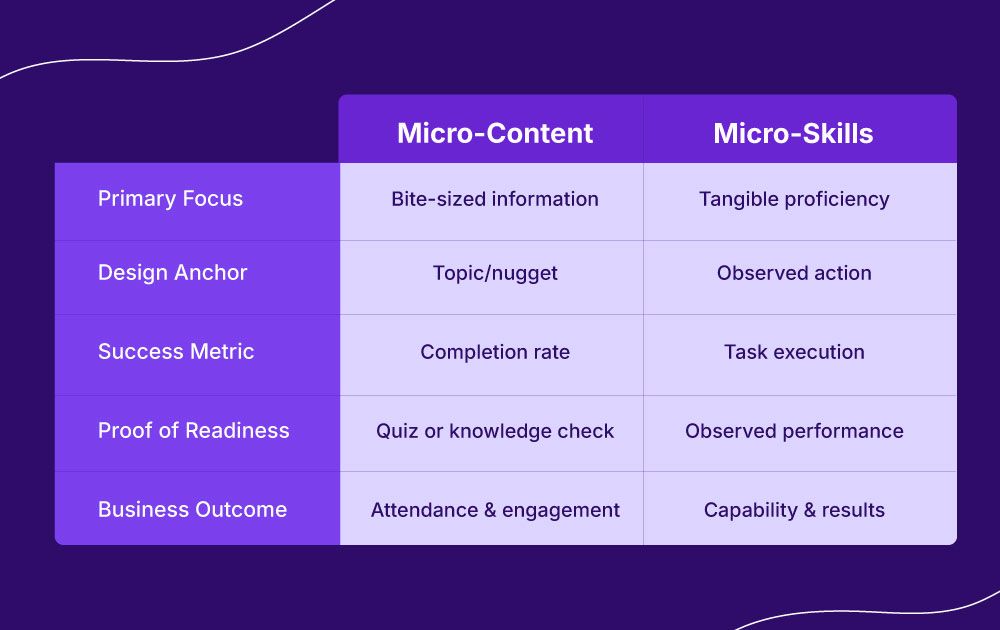
One of the most important clarifications in the 2026 blueprint is the distinction between micro-content and micro-skills. Micro-content is a delivery choice. It optimizes for consumption. Micro-skills are an outcome choice. They optimize for performance.
A micro-skill is not defined by duration. It is defined by function. It represents a specific task, decision, or behavior that matters in a role and can be demonstrated under real conditions. Without this distinction, organizations accumulate large libraries of short assets that never add up to readiness. When learning is broken into small pieces without coherence, practice, or validation, learners may understand concepts but remain unable to apply them consistently.
This is why many microlearning initiatives look active while leaving deployment risk unchanged. For enterprise L&D, this requires redefining the smallest unit that matters. The unit is not a video or a module. It is a task that can be executed correctly under real conditions.
The Practical Blueprint for Micro-Skills That Stick
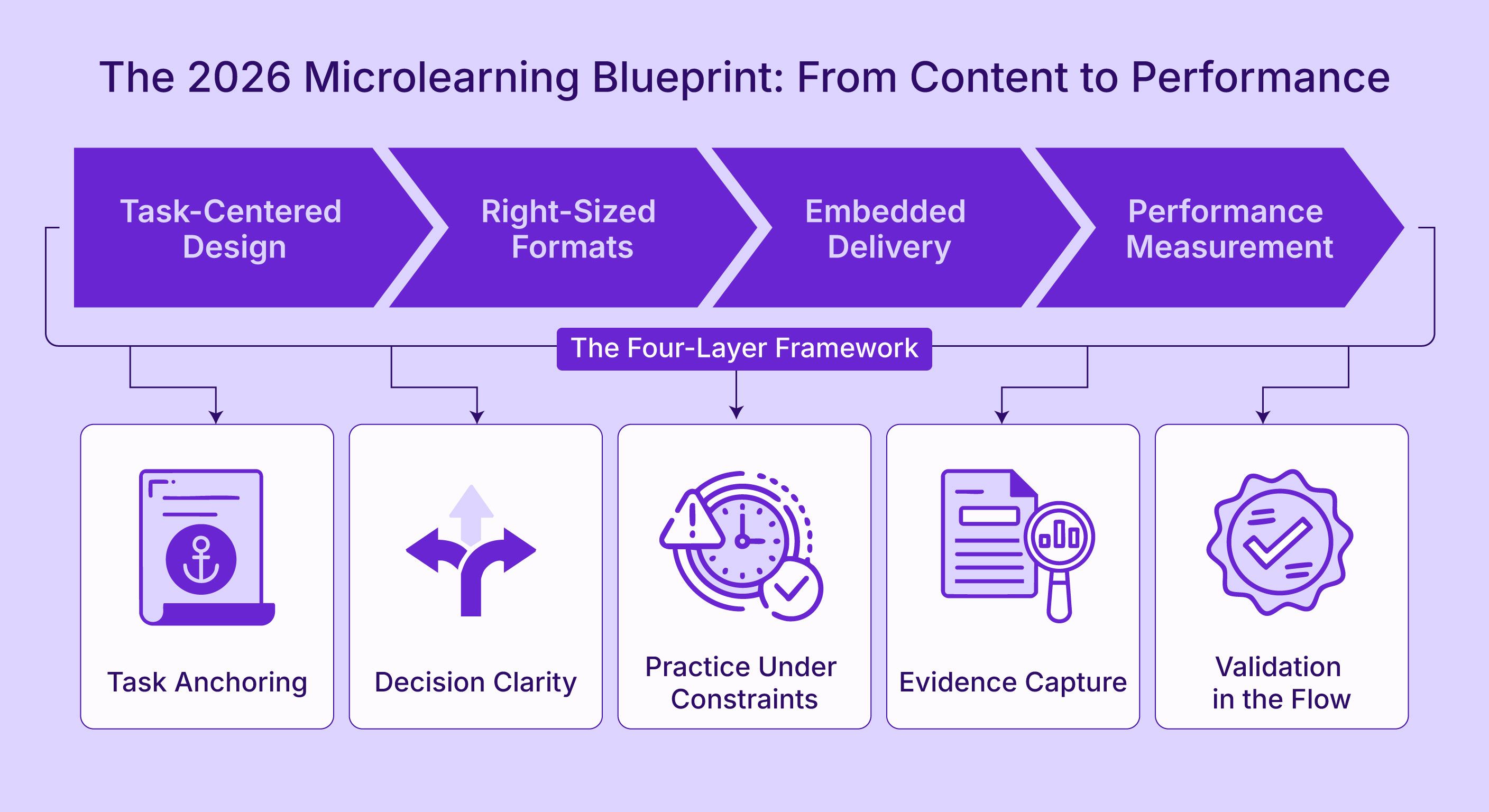
The practical blueprint for 2026 is built upon a four-layer framework supported by five design principles for task-anchored micro-skills.
The Four-Layer Blueprint
To move from content fragmentation to performance enablement, L&D teams should follow these four layers:
1. Task-Centered Design: Development must start with the job, not the content. Designers should identify what task the learner is struggling with, what specific decision must be made, and what risks must be avoided. Each asset should support one task, one decision, or one behavior.
2. Right-Sized Formats: 2026 microlearning moves beyond video-centricity to include formats like checklists, interactive decision trees, simulations, and reflective nudges. The design implication is to choose the fastest format that enables correct performance, rather than the most engaging one.
3. Embedded Delivery: Learning should happen in the flow of work so learners do not have to "leave work to learn". This includes learning prompts inside business systems, contextual help embedded in tools, and searchable on-demand assets.
4. Performance-Based Measurement: Success is no longer measured by completion rates. Instead, the focus is on performance indicators such as decreased error rates, improved task completion time, increased decision quality, and declining support requests.
The Five Pillars of Task-Anchored Micro-Skills
To ensure these micro-skills "stick," the blueprint incorporates five core principles:
• Task Anchoring: Every skill must be tied to an observable, real-world action.
• Decision Clarity: Training must focus on judgment in context, including constraints and trade-offs, as most failures occur at decision points.
• Practice Under Constraints: Learning must reflect real working conditions, such as time pressure or incomplete information.
• Evidence Capture: A skill is only considered "complete" when there is proof of execution, such as a validated output or system action.
• Validation in the Flow of Work: This involves lightweight confirmation by managers or role owners to ensure work was performed correctly.
Where Most Enterprises Break the Model
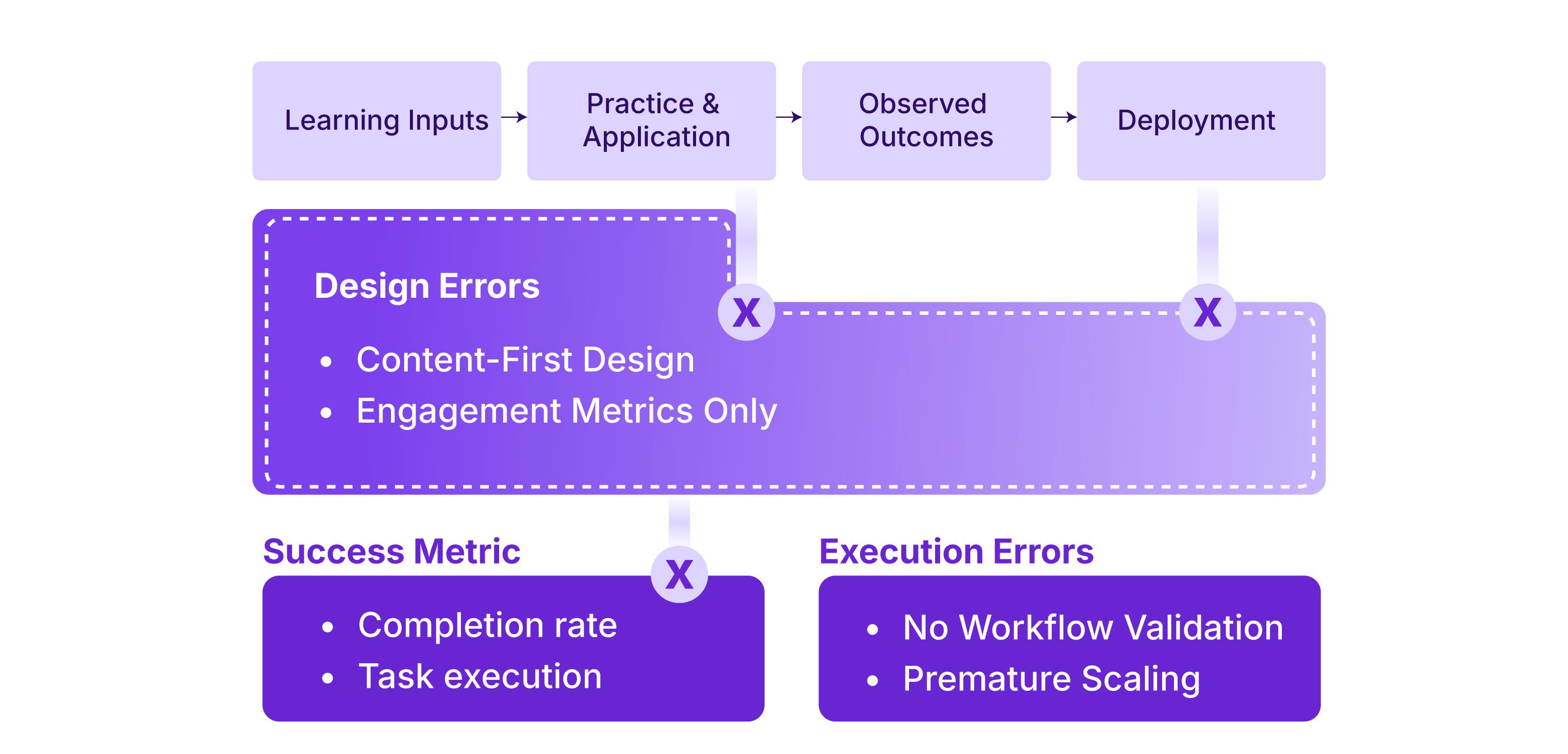
Most microlearning initiatives fail in predictable ways. They start with content instead of tasks. Existing courses are broken into smaller pieces without redefining what correct execution looks like in the role. They optimize for engagement metrics rather than readiness signals. Completion rates are tracked because they are easy to report, not because they reduce operational risk.
They isolate learning from management. Without feedback in real workflows, learners rarely know whether they applied skills correctly or consistently. They scale before validating impact. Microlearning is rolled out broadly before proving that it reduces errors, improves speed, or stabilizes quality in a specific role. eLearning Industry cautions that microlearning without structure increases fragmentation risk. Speed without architecture creates activity, not capability.
What Enterprise L&D Leaders Should Do Next
This shift does not require rebuilding the entire learning ecosystem. It requires changing how decisions are made. Start with one role and identify a small set of tasks that most strongly influence business outcomes. These become the anchors for micro-skills. For each task, define the decision that matters, the practice action required, and the evidence that proves readiness. This reframes learning design around execution, not content volume.
Clarify ownership early. L&D designs the system. Business leaders define what “good” looks like. Managers provide fast validation in the flow of work. Address scale deliberately. Standardize the micro-skill structure, but allow local execution within roles. This balances consistency with operational reality. Treat micro-skills as pilots, not transformations. Validate impact in one role before expanding. Measure what leaders actually care about: fewer errors, faster ramp-up, more confident deployment.
The Question Every Executive Will Ask in 2026
In 2026, the question will not be whether your organization uses microlearning. The question will be whether leadership can trust learning outputs when making deployment decisions. If learning cannot tell you who is ready for real work, it is not reducing risk. If it cannot shorten time-to-competency, it is not keeping pace with change. Microlearning only earns its place when it produces observable capability at speed. Everything else is content, no matter how small.
Sources
Microlearning in 2026: A Practical Blueprint, Not Just Bite-Sized Content
 Author
Sameer Desai
Head of Technical Learning Solutions 124 Articles Published
124 Articles Published
Sameer Desai is an EdTech and technology solutions leader with over 10 years of experience across learning, operations, and business growth. His journey from Corporate Trainer to General Manager, Technology Solutions has enabled him to build scalable learning ecosystems, expand service portfolios, and deliver consistent double-digit growth with strong margins. He excels at engaging senior stakeholders and leading end-to-end learning initiatives from requirement analysis through solution design and implementation. Sameer was a founding team member behind IIHT’s Digital Learning Platform, Techademy, where he led customer operations, success management, and the setup of a Unified Service Desk with IVR support.
Share