


The Quiet Rewrite of Enterprise Skills Frameworks
 AuthorSonal Modi
 Published03 Mar 2026
 Views75
 Read time5 mins


Executive summary
Enterprise skills frameworks are quietly becoming strategic infrastructure.
AI is changing how decisions are made across functions, yet most organizations are still relying on static competency models built for stability. When skills architecture lags behind real workflow shifts, hiring misaligns, governance weakens, and risk accumulates invisibly. Forward-looking enterprises are redefining skills around real decision use cases, not generic capability labels. The next 12–18 months will determine whether skills frameworks become a competitive advantage - or a hidden liability.
Why This Is Emerging Now
Three forces are converging within a compressed timeframe. AI deployment cycles are accelerating faster than HR architecture refresh cycles. Regulatory expectations are tightening, increasing audit scrutiny. Meanwhile, workforce planning is moving from linear forecasting to scenario-based modeling.
When frameworks lag behind work, downstream systems misfire. Hiring profiles misalign with actual task demands. Learning investments reinforce outdated competencies. Audit committees receive assurance signals disconnected from operational reality.
This shift is operational, not theoretical.
Static Skill Frameworks Are Quietly Breaking
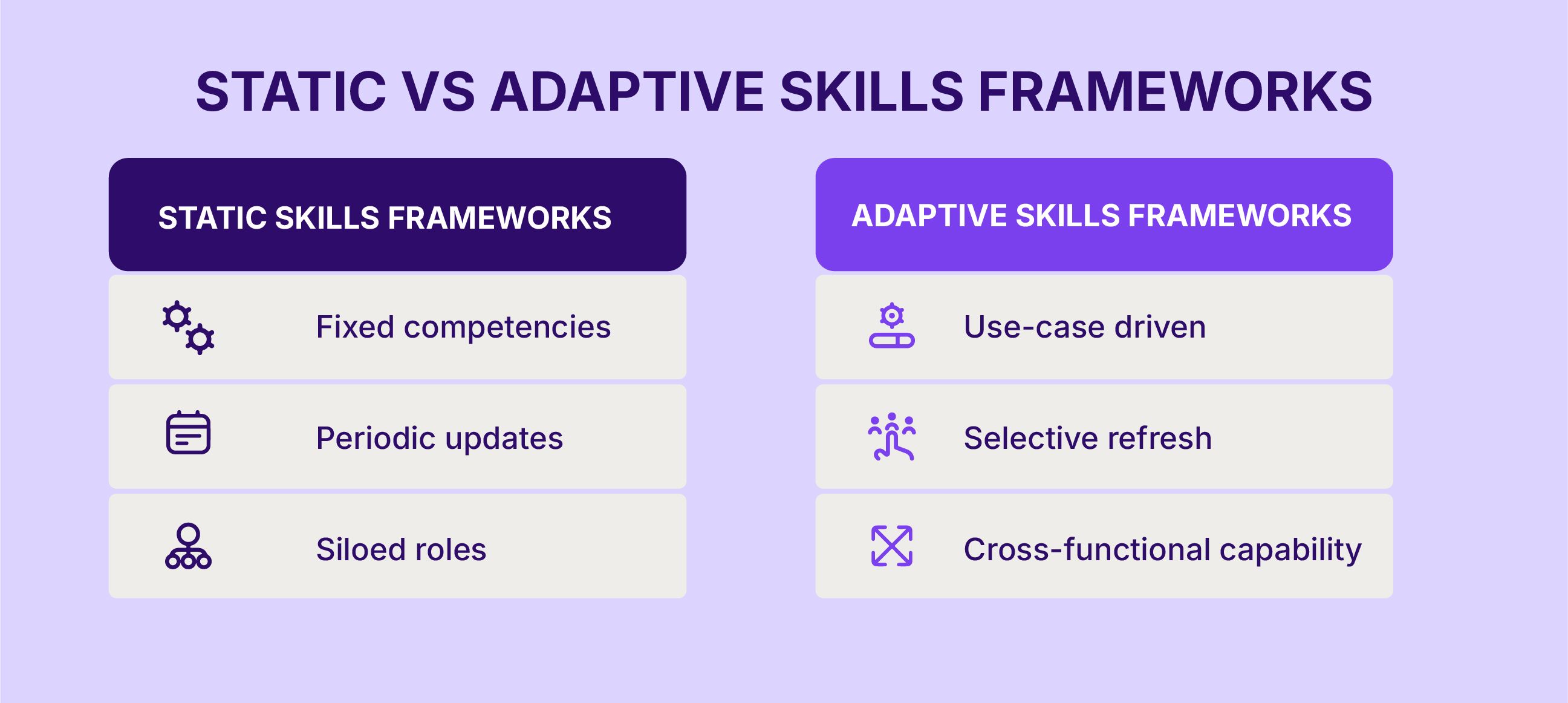
Traditional skills architectures were designed for stability. Competencies were defined at job-family level and updated periodically. That cadence no longer matches AI-driven workflow change.
The Josh Bersin Company highlights that organizations are resetting taxonomies to reflect AI-integrated roles and hybrid capability demands The break unfolds gradually, which makes it harder to detect. Hiring pipelines begin optimizing for legacy competencies. Learning programs emphasize skills automation is absorbing. Performance metrics evaluate outdated output models. This misalignment rarely triggers immediate crisis. Instead, it accumulates execution drag.
AI Is Blurring Role Boundaries Faster Than HR Can Update Them
AI is not merely automating tasks. It is redistributing decision authority and accountability. Reuters reports increasing regulatory scrutiny on enterprise AI deployment. MIT Sloan emphasizes that responsible AI outcomes depend on employee-level fluency
This means marketing leaders interpret AI-generated forecasts, HR teams review algorithmic hiring outputs, and finance managers validate automated projections. Capability requirements are spreading horizontally across functions. Yet most job architectures remain vertically siloed. That gap is where risk accumulates.
From Skill Lists to Capability Use Cases
Organizations are shifting from abstract skill labels to workflow-anchored capability definitions. Instead of listing “AI proficiency,” capability is defined as a decision scenario tied to measurable output. For example:
A global procurement function updates its framework after integrating AI-driven supplier risk analysis. Rather than listing “data literacy,” the revised capability states: *Validate AI-generated supplier risk scoring against compliance policy and escalate anomalies within defined thresholds.* This use case clarifies accountability and creates observable readiness criteria. The Bersin analysis supports this directional shift toward use-case-driven taxonomies
Use cases sharpen hiring accuracy, learning alignment, and governance defensibility.
Scenario Planning Is Reshaping Workforce Architecture
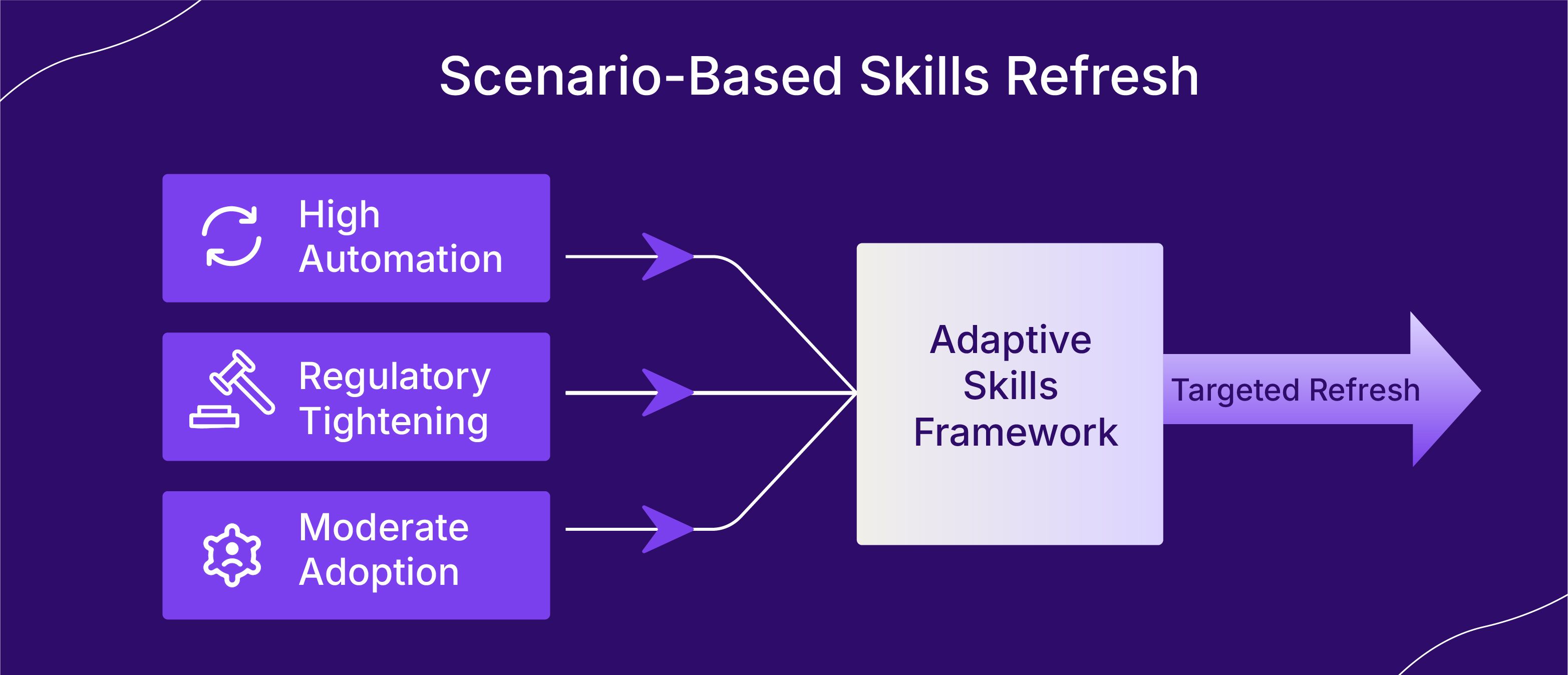
Gartner’s January 2026 press release notes increased use of scenario planning to manage AI volatility Scenario modeling assumes uncertainty. Automation may accelerate. Regulatory regimes may tighten. AI investment may plateau. Each scenario alters skill emphasis.
This does not require quarterly enterprise-wide redesign in every organization. Refresh cadence should reflect volatility exposure and organizational maturity. Highly regulated industries may require faster cycles. Stable operational domains may require selective updates. Adaptive frameworks enable targeted refresh without destabilizing compensation bands, workforce analytics, or reporting continuity.
Governance Is Becoming a Skills Issue
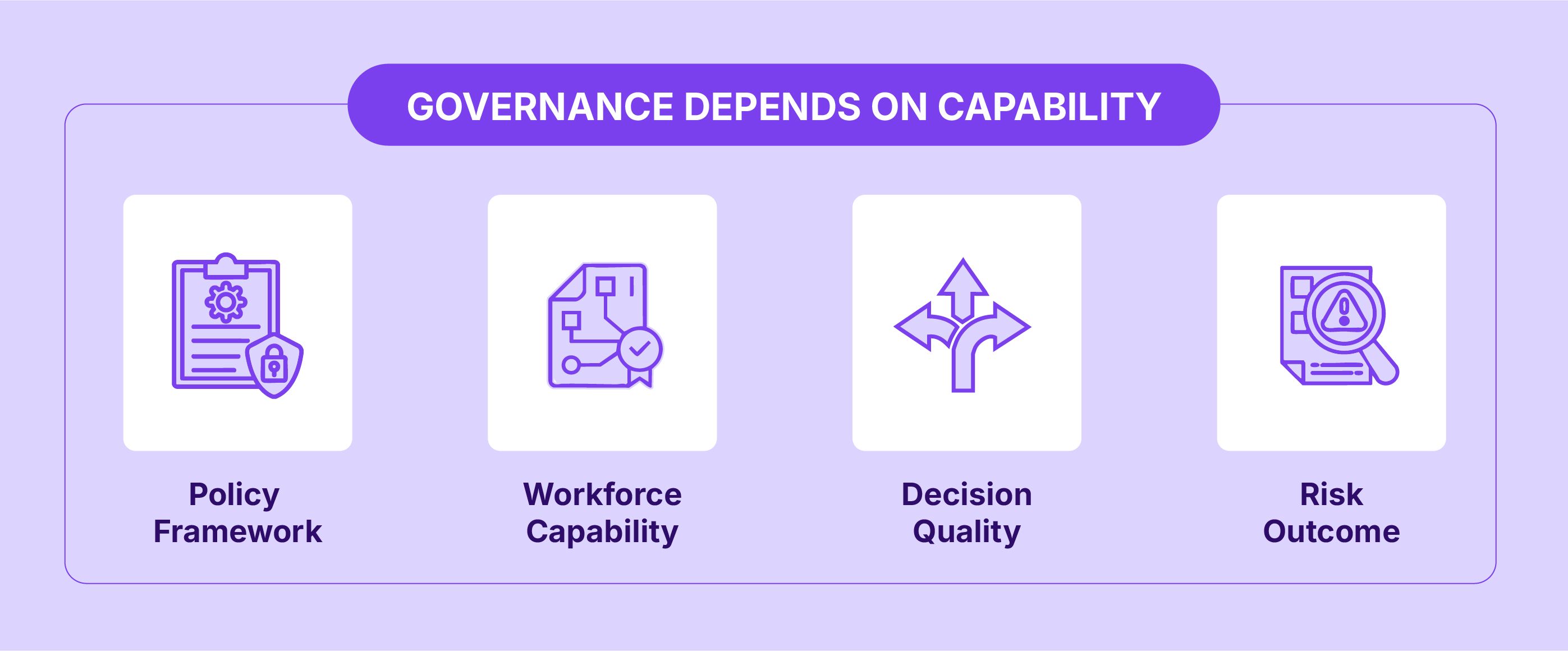
Governance failures increasingly reveal decision-quality gaps rather than policy gaps.
Example scenario:
An HR team relies on AI screening to shortlist candidates. Without defined capability expectations around bias detection and override judgment, discriminatory patterns go unnoticed until regulatory review. The failure is not policy absence. It is capability absence.
MIT Sloan and Reuters both emphasize that responsible AI depends on workforce understanding and regulatory scrutiny is intensifying. This reframes governance as a skills architecture challenge. Audit committees and enterprise risk leaders increasingly require evidence that capability definitions reflect AI-integrated decision points.
What Often Goes Wrong in Taxonomy Rewrites
Common failure patterns include:
- Over-modeling every skill across the enterprise simultaneously.
- Vendor-led redesign disconnected from business ownership.
- Excessive dynamism that destabilizes compensation and career pathing.
- Ignoring HRIS data dependencies and reporting structures.
Dynamic does not mean chaotic. In stable operational roles, over-frequent redesign creates confusion and erodes trust. Selective, business-owned refresh is more sustainable than sweeping transformation.
A Practical Playbook for Rewriting Skills Frameworks
- Clarify Ownership Boundaries
CHRO defines architecture standards. CLO aligns learning systems. Workforce planning teams model scenarios. Risk and audit functions validate governance exposure.
- Prioritize AI-Exposed Roles
Begin where workflow volatility or regulatory exposure is highest.
- Develop Capability Use-Case Libraries
Translate abstract skills into decision scenarios tied to measurable outcomes.
- Create Capability Heatmaps
Map current proficiency against emerging use cases to identify material gaps.
- Align Refresh Cadence to Volatility
Update selectively based on scenario signals, not calendar obligation.
- Stress-Test Governance Implications
Validate that AI-integrated decision points are reflected in capability definitions before regulatory scrutiny exposes gaps.
This sequencing reduces enterprise disruption while increasing strategic alignment.
Five Key Takeaways for Enterprise L&D Leaders
- Static skill libraries increasingly misalign with AI-driven workflows.
- Capability use cases provide clearer governance and hiring signals than abstract labels.
- Scenario-based planning requires adaptable but disciplined taxonomies.
- Governance credibility depends on distributed decision capability.
- Selective refresh outperforms sweeping redesign.
The Next 12–18 Months Will Define Your Skills Architecture
Within the next 12–18 months, boards, regulators, and executive teams will demand clearer evidence that workforce capability aligns with AI-integrated operations.
Skills frameworks influence hiring precision, learning investment, mobility credibility, and risk oversight. When they drift from operational reality, friction accumulates invisibly.
The rewrite is already underway. The strategic choice is whether to lead it deliberately or react to it under external pressure.
 Author
Sonal Modi
Chief Operating Officer 124 Articles Published
124 Articles Published
Dr. Sonal Sushil Modi, Ph.D., CPLP®, ATD Certified, is an accomplished learning & development expert with a passion for helping professionals elevate their skills. With extensive experience in designing and delivering transformative learning programs, she bridges academic rigor with real-world application. Her work focuses on leadership development, performance improvement, and building capability in individuals and teams. When she’s not crafting impactful training experiences, Sonal enjoys exploring thought leadership in workplace learning and mentoring future learning professionals.
Share