


Burnout Is a Work Design Problem, Not a Resilience Problem
 AuthorAkarshitha J Gargi
  Published25 Feb 2026
 Views50
 Read time12 mins


Executive summary
Most organizations respond to rising burnout with good intentions: meditation app subscriptions, resilience workshops, wellness Wednesdays. These initiatives have value. But they are not addressing the deeper issue.
Burnout is not a personal failing, and it is not a sign that employees need better coping strategies. It is, at its core, a design flaw in how work is structured, distributed, and managed. When L&D and HR leaders treat it purely as a wellness issue, the root causes of exhaustion remain intact, and productivity, engagement, and retention continue to erode.
This piece is about what L&D leadership can become when it moves beyond program delivery and into the structural fabric of how work gets done. Not every L&D function has this influence today. But the path to earning it starts with understanding where burnout actually comes from and demonstrating that learning strategy can address it at the root.
The Data: Burnout Has Become a Structural Crisis
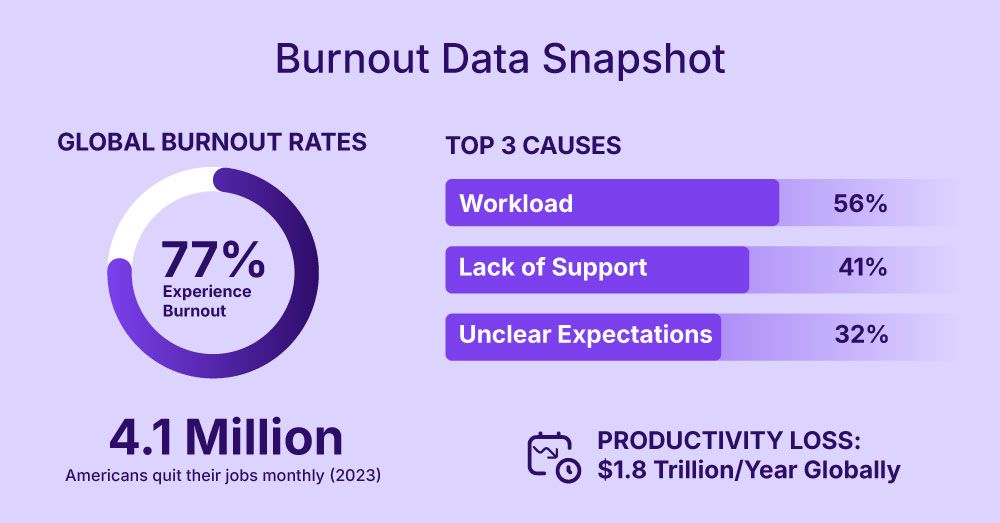
The scale of workplace burnout is now difficult to ignore. The 15th annual Aflac WorkForces Report (October 2025) found that burnout among American employees has reached a seven-year high, with Gen Z surpassing Millennials as the most affected generation at 74% experiencing moderate or higher burnout levels.
Eagle Hill Consulting's Workforce Burnout Survey (November 2025) reports that 55% of the U.S. workforce is currently experiencing burnout, and that burnt-out employees are nearly three times more likely to leave their employer within the coming year.
What matters most for L&D leaders is what sits behind these numbers. The primary drivers of burnout are not personal shortcomings. They are organizational design failures: heavy workloads, limited autonomy, unclear role expectations, poor leadership, and a lack of career development opportunities.
Gallup's State of the Global Workplace 2025 report (released April 2025) confirms this pattern. Global employee engagement fell to 21% in 2024, with lost productivity costing the global economy an estimated $438 billion. The report identifies manager disengagement as the primary driver, with manager engagement dropping from 30% to 27%, and 70% of team engagement variance attributable to the manager.
Why Perks and Programs Cannot Fix Structural Stress
Most organizations respond to burnout data by layering on wellbeing perks: mindfulness apps, gym memberships, mental health days, or resilience training modules. These are well-intentioned, and they do provide value to individual employees. But they are insufficient when the underlying structure of work remains unchanged.
HR.com's Future of Employee Well-being 2025 report (surveyed April to July 2025) found that 57% of organizations describe burnout as difficult to reduce. Only 41% say their wellbeing programs are truly effective. The report identifies a clear pattern: programs tend to address physical and mental health in isolation while leaving workload design, digital overload, financial stress, and unsustainable workflows largely untouched.
Consider the analogy: offering a yoga class to an employee drowning in an unrealistic workload, navigating unclear priorities from multiple managers, and lacking the skills to use a newly implemented tool helps momentarily. It does not address the source of the problem.
The cost of leaving these structural issues unaddressed is substantial. Burnout-driven productivity losses and voluntary turnover cost companies an estimated $322 billion annually, with an additional $125 billion to $190 billion in healthcare expenses tied to stress-related conditions. For a 1,000-person company, burnout can translate to over $5 million in annual losses through disengagement and reduced effectiveness alone. These are the figures CLOs need when building a business case for work redesign with a CFO or CEO.
This aligns with decades of established research on work design. The Job Demands-Resources (JD-R) model, a foundational framework in organizational psychology first published in 2001, has long demonstrated that sustainable wellbeing comes from reducing excessive demands and strengthening resources at the system level, not from individual-level interventions alone. More recently, MIT Sloan Management Review (December 2024) published research confirming that when jobs include positive characteristics such as autonomy, variety, and social support, employees are more motivated, committed, and less likely to burn out.
For CLOs and OD leaders, this calls for a shift in framing. The question moves from "How do we help employees cope with stress?" to "How do we redesign workflows, roles, and management practices so that chronic stress does not accumulate in the first place?"
The Hidden Link Between Skill Gaps and Work Overload
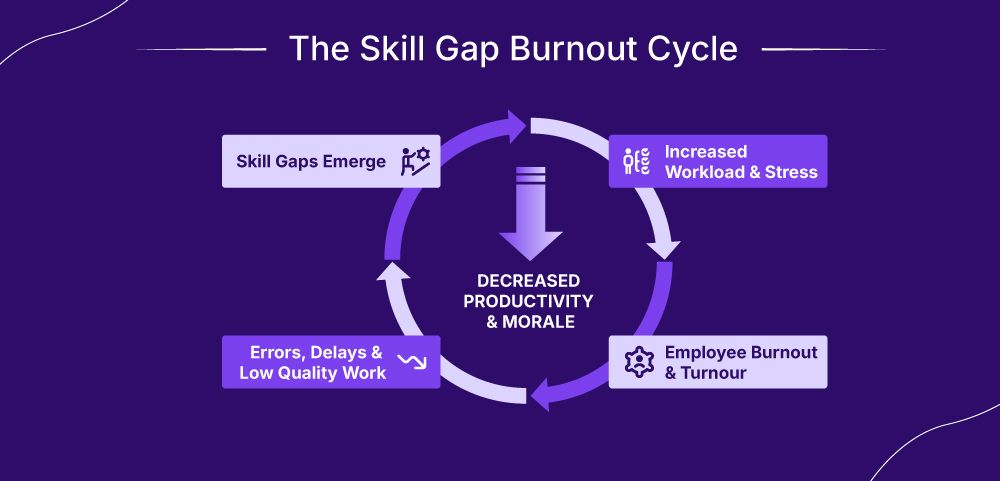
One of the most underappreciated drivers of burnout is something L&D leaders know well: skill gaps. When employees lack the right skills for their roles, everything takes longer, feels harder, and produces more friction. Tasks that should take an hour take three. Confidence erodes. Errors multiply.
The emotional toll compounds day after day. Research suggests that a lack of job-specific skills increases burnout risk by slowing productivity, raising operational costs, and creating a persistent sense of inadequacy. Monster's 2025 State of the Workweek report found that 73% of full-time workers regularly work beyond 40 hours per week, with 50% reporting mental health challenges as a direct result. When those additional hours come because employees lack the proficiency to work efficiently, the result is exhaustion rather than growth.
The University of Phoenix Career Institute's 2025 research underscores this connection. Younger workers, particularly Gen Z and Millennials, report both the highest demand for training and the highest burnout rates. While the relationship between skill gaps and burnout is supported by converging evidence rather than controlled studies, the operational logic is consistent: when employees lack the tools to meet role demands efficiently, the daily friction accumulates. The gap between expectations and capability becomes a persistent source of stress.
This dynamic is accelerating. As organizations deploy AI tools, automation platforms, and new tech stacks at pace, the gap between role demands and employee capabilities is widening faster than most L&D teams can close it. Microsoft's 2025 Work Trend Index reported a 42% rise in digital exhaustion, and Deloitte's 2025 Workforce Intelligence Report identified cognitive strain and decision friction as now surpassing workload volume as the leading indicators of burnout. The skill gap conversation is no longer just about technical proficiency. It is about helping employees navigate an entirely new cognitive landscape.
This is where L&D has a direct and practical lever. Closing skill gaps is not just a performance strategy; it is a burnout prevention strategy. When employees have the competencies they need to meet their role demands, they work faster, feel more confident, and experience less chronic frustration. But this requires more than offering a catalog of courses. It requires diagnosing specific capability gaps at the team and role level and delivering targeted interventions that directly reduce the friction in how work gets done.
Embedding Learning Into Work Design: Practical Tactics
The most forward-thinking L&D teams in 2025 are no longer operating as content delivery functions. They are acting as work design partners. Instead of building training programs in isolation and hoping they reduce burnout, these teams collaborate with operations, product, and engineering leaders to embed learning directly into the structure of work.
What does this look like operationally?
Conduct role-level skill assessments before restructuring teams or deploying new technology. When organizations introduce new tools or processes without first understanding whether employees have the skills to use them, they create invisible overload. Assessments that map existing capabilities against role requirements can pinpoint where friction lies and where targeted skilling can remove it.
Integrate microlearning into workflow touchpoints. Rather than pulling employees away for day-long training sessions, deliver learning at the point of need. A two-minute tutorial embedded in the tool an employee is struggling with does more to reduce frustration than a three-hour course attended six months ago.
Use assessment data to inform workforce planning. If skill gap data consistently shows that a particular team lacks proficiency in a critical area, that is not just a training problem. It is a signal that the team may be under-resourced, that role expectations need adjusting, or that hiring priorities should shift. L&D leaders who surface these insights to the C-suite move from running programs to shaping organizational decisions.
What this looks like in practice:
When a mid-size financial services firm rolled out a new analytics platform across its operations team, the L&D function ran a pre-deployment skill assessment across 350 customer-facing roles. The assessment revealed that 42% lacked proficiency in the platform's reporting module, and 28% were unfamiliar with the underlying data concepts. Rather than a blanket training rollout, L&D delivered targeted 90-minute workshops to the identified groups and embedded short reference guides directly into the platform interface. Within the first month, support ticket volume related to the new tool dropped by 30%, and manager-reported overtime for the affected teams decreased. The L&D team presented this data to the COO, reframing the intervention not as "training" but as "deployment friction reduction." That conversation led to a standing partnership between L&D and the technology rollout team for all subsequent implementations.
Training Industry (December 2025) reports that L&D teams are now embedding training on stress management, emotional resilience, and burnout prevention directly into leadership development and broader skills training, rather than treating wellbeing as a standalone topic.
Manager Enablement: The Most Underinvested Burnout Prevention Strategy
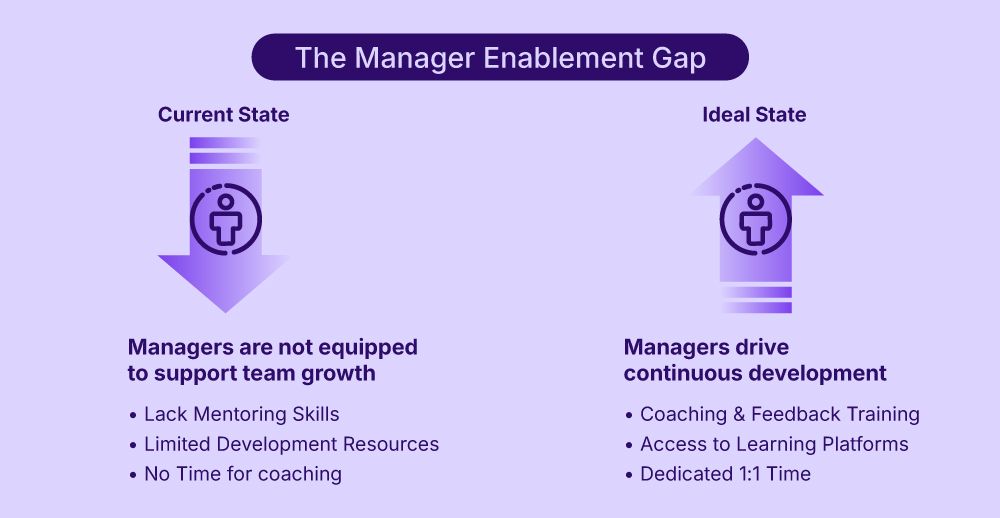
If work design is the structural cause of burnout, managers are the frontline where it either gets prevented or amplified. Gallup's 2025 data is unambiguous: manager engagement experienced the sharpest decline among all employee groups, dropping from 30% to 27%. Young managers under 35 fell five points; women managers fell seven points. When managers are disengaged or unskilled in people leadership, the effects cascade across every team they touch.
Eagle Hill Consulting found that many employees say their burnout concerns go unaddressed by their managers. The Aflac WorkForces Report shows that only 48% of employees in 2025 believe their employer genuinely cares about their mental health, down from 54% in 2024. This perception gap is a leadership capability problem, not just a branding challenge.
Yet HR.com's 2025 research on mental health in the workplace found that only 14% of managers have been trained to recognize and respond to stress. This creates a compounding problem: untrained managers cannot identify workload imbalances, redistribute tasks effectively, hold honest conversations about capacity, or foster psychological safety on their teams.
From Framework to Reality: Designing Work That Builds Capability and Energy
The SMART Work Design model, developed by researchers Sharon K. Parker and Caroline Knight at Curtin University and published in Human Resource Management (2024), provides a validated framework for understanding what good work design looks like. Building on the foundational Job Characteristics Model (Oldham and Hackman, 1976) and the JD-R model, SMART identifies five higher-order categories: Stimulating work, Mastery opportunities, Autonomy, Relational support, and Tolerable demands.
For L&D leaders, this framework translates into a clear strategic integration point. Instead of treating learning as a separate activity layered on top of demanding roles, design learning experiences that make work itself more stimulating and manageable. Create development pathways that build mastery over the skills each role requires. Advocate for role structures that provide autonomy and decision-making authority. Build learning communities that strengthen relational connections across teams.
The goal is an environment where growth does not compete with productivity, and where upskilling reduces overload by making people more effective at what they do rather than adding another demand to an already full plate.
Acknowledging the Real Constraints
None of this happens in a vacuum. L&D leaders operate within real organizational constraints: tightening budgets, HRBP alignment challenges, IT tool rollout complexity, and the very manager overload this article describes. Influencing work design requires cross-functional credibility, not just good ideas. It means learning to speak the language of operations, finance, and product teams. It means presenting skill gap data in terms of business impact, not training completions.
In most organizations, work design has no single owner. It sits across HR, operations, IT, and business leadership. L&D's role is not to claim ownership but to provide the capability data that makes cross-functional redesign conversations possible, and to demonstrate, through early wins, that learning interventions can measurably improve how work flows.
This also requires honesty about measurement maturity. Most L&D functions are still reporting on course completions and satisfaction scores. HR.com's data shows only 30% of organizations believe they are effective at measuring the impact of wellbeing initiatives. Building the diagnostic capability to assess role-level skill gaps and connect those gaps to business outcomes is itself an investment, and it is a prerequisite for the kind of influence this article describes.
The most effective approach is often incremental: start with one business unit, run a focused capability assessment, identify the three to five skill gaps creating the most friction, deliver targeted interventions, and measure the impact. The metrics that matter for a pilot like this include time-to-competency for newly deployed tools, internal mobility rate within the assessed team, manager-reported workload balance scores, and the team-level engagement delta between pre- and post-intervention pulse surveys. When that pilot produces measurable movement on two or three of these indicators, the conversation with senior leadership shifts from "Can L&D influence work design?" to "Where should we do this next?"
The Path Forward: From Wellness Programs to Work Redesign
The data is moving in the wrong direction, and organizations still relying on individual-level wellness perks to address a systemic problem will continue to see diminishing returns. For CLOs, HR leaders, and organizational development heads, the opportunity is to reposition L&D as a driver of work design, not just a provider of courses.
That starts with asking honest, specific questions. What are the skill gaps creating the most friction in your teams right now? Where are managers under-equipped to support their direct reports? Which roles carry unsustainable demands because employees lack the capabilities to meet them efficiently?
The answers will not come from another engagement survey alone. They require granular, role-level capability assessments that reveal the real picture of workforce readiness and connect learning investment to the structural conditions that either prevent or produce burnout.
Sources
Aflac WorkForces Report, 15th Annual (October 2025)
Eagle Hill Consulting Workforce Burnout Survey (November 2025).
Gallup, State of the Global Workplace 2025 (April 2025).
HR.com, Future of Employee Well-being 2025 (April-July 2025).
HR.com, State of Employee Mental Health & Stress in the Workplace (June 2025).
Monster, State of the Workweek 2026 (October 2025 survey).
Training Industry, "The L&D Revolution: 7 Trends" (December 2025).
University of Phoenix Career Institute, Burnout and Autonomy in the Modern Workforce (2025).
Wellhub, Workplace Wellness Strategies (2025). Cites $322B burnout cost figure.
 Author
Akarshitha J Gargi
Manager – Human Resource 124 Articles Published
124 Articles Published
Akarshitha is an accomplished HR and operations leader with over 12 years of experience driving people strategy and business excellence. With a strong background in Operations and HR Business Partnering, she brings a balanced approach that blends strategic insight with hands-on execution. Her work centers on talent management, employee engagement, workforce planning, and building high-performance cultures that align with organizational goals. Passionate about workplace transformation and continuous improvement, Akarshitha is committed to creating environments where individuals thrive and businesses grow. When she’s not optimizing people practices and operational workflows, she enjoys exploring innovative HR technologies and mentoring emerging professionals in the field.
Share