

 Resources AI-Augmented Performance Support: The Reinforcement Layer Enterprises Are Building in 2026
 AI-Augmented Performance Support: The Reinforcement Layer Enterprises Are Building in 2026
 AuthorShrinivas Karthik
 Published06 Mar 2026
 Views350
 Read time8 mins


Executive summary
AI in Learning & Development has entered a new phase in 2026. The first wave focused on automating content creation -faster courses, AI-generated summaries, adaptive quizzes. That efficiency layer is now stabilizing. Emerging signals show a structural shift: AI is becoming a reinforcement layer embedded inside work. Industry outlooks for 2026 highlight AI’s expanding role in feedback loops and reflective performance support. At the same time, outcomes-led learning is redefining L&D strategy around measurable business impact.
Meanwhile, AI investment continues to accelerate while structured workforce enablement remains uneven across organizations. For boards and CFOs, this raises a practical question: how do AI investments translate into margin stability, risk reduction, and predictable performance? The answer increasingly lies in reinforcement architecture.
The Problem: AI Rollouts Are Outpacing Behaviour Adoption
AI tools are expanding across finance, HR, customer operations, and compliance. Expectations are high. Productivity gains are assumed. Risk mitigation is promised. However, workforce behaviour often lags behind technology deployment. Despite continued AI investment, systematic upskilling and behavioural reinforcement remain inconsistent in many enterprises.
The gap is no longer information. It is sustained behavioural reinforcement at the point of decision. Traditional L&D responses increase exposure but not necessarily adoption. Knowledge does not automatically convert into consistent decision quality under time pressure. Reinforcement bridges that gap by shaping behaviour in context.This does not replace capability development. It strengthens it by supporting application where it matters.
What’s Changing: AI Moves from Content Engine to Reinforcement Layer
The conversation is shifting from content production to performance architecture. Recent 2026 industry analysis emphasizes AI’s role in reflective loops embedded within work systems. Learning effectiveness is now measured through outcome alignment rather than participation metrics.
AI becomes most valuable when it reinforces decisions at the precise moment risk, ambiguity, or time pressure is highest. This reframes L&D’s role. It becomes less about content orchestration and more about decision reinforcement design.
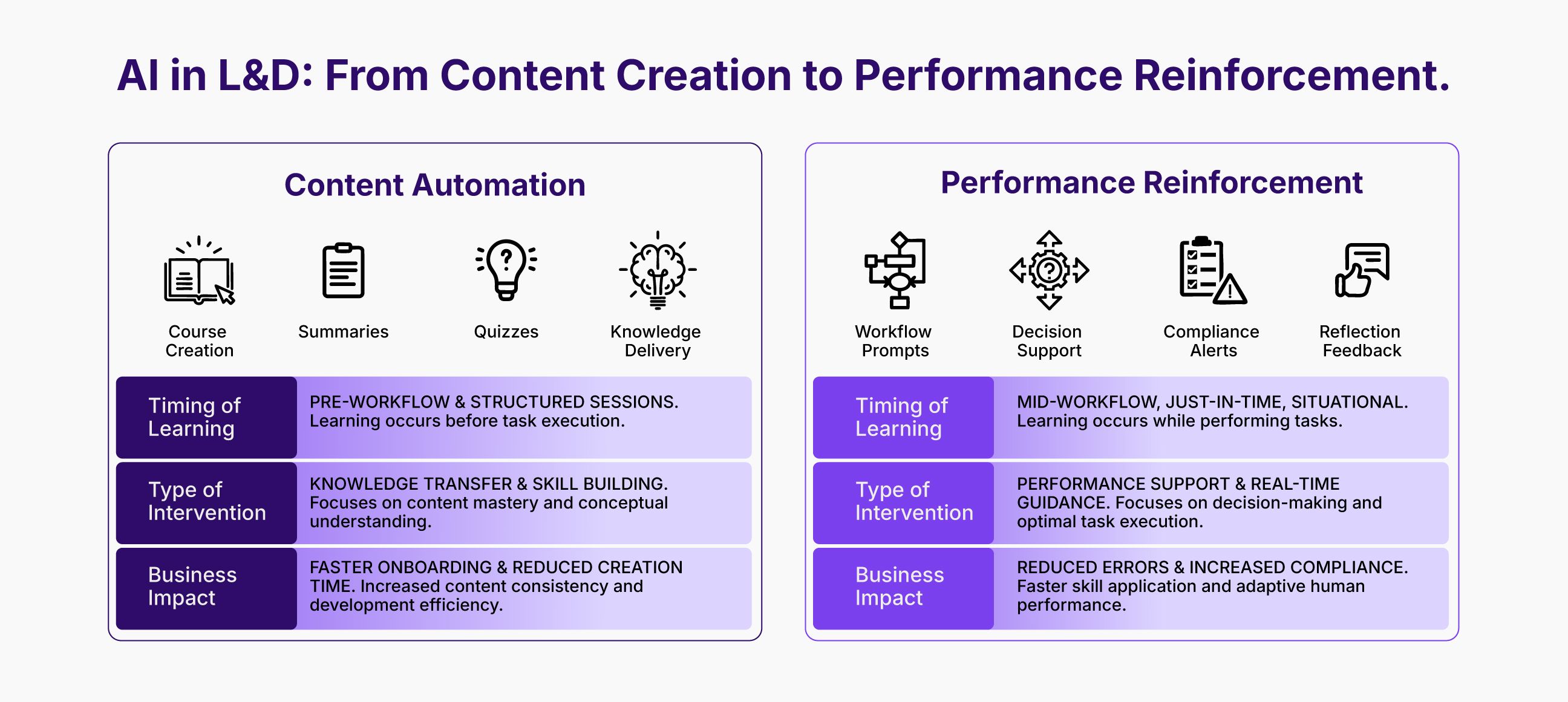
From Courses to Continuous Performance Prompts
Performance enablement in the flow of work is gaining traction. Embedded learning models are increasingly highlighted as the mechanism for translating knowledge into consistent behaviour.
Reinforcement may take the form of:
• AI prompts within CRM systems suggesting corrective actions
• Compliance alerts prior to regulatory submission
• Structured reflection prompts before financial sign-off
• Bias detection nudges during hiring reviews
Learning no longer happens primarily before work. It happens during work.
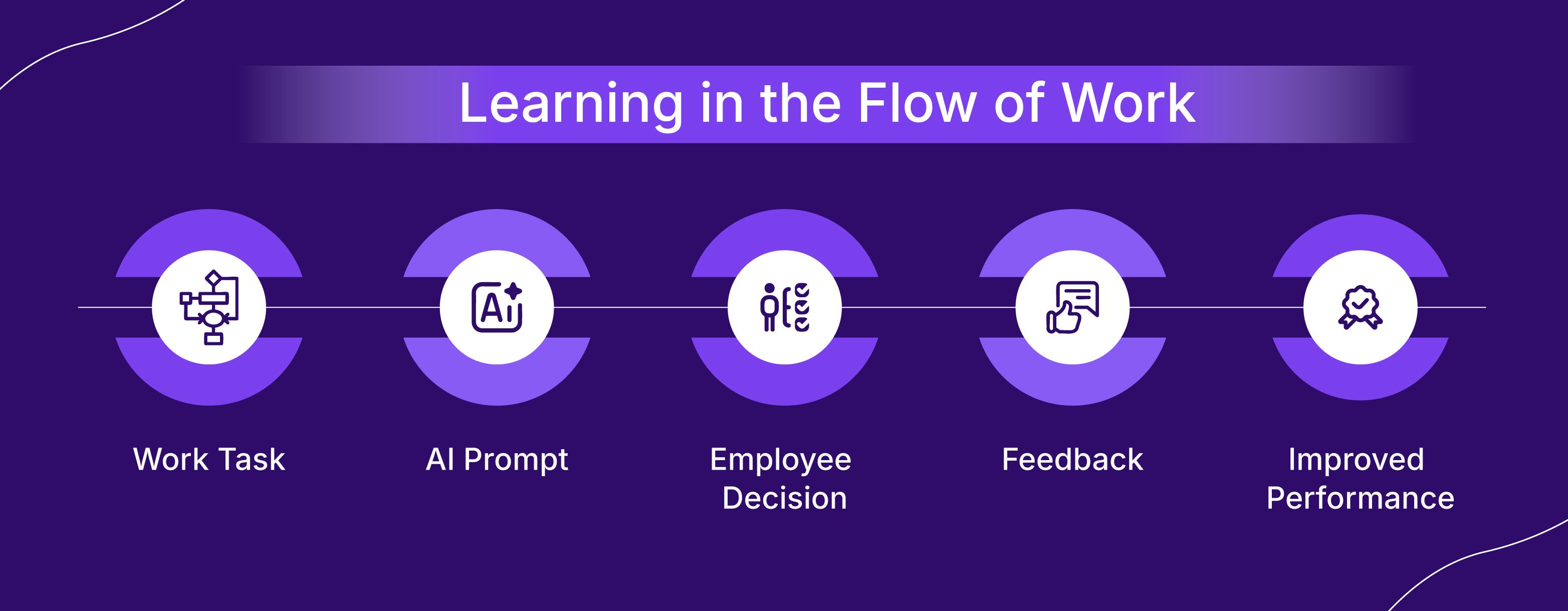
AI as Digital Coach Inside Workflows
When designed intentionally, AI can act as a contextual digital coach. It can surface micro-feedback after key decisions, reinforce regulatory thresholds, suggest risk-adjusted alternatives, and prompt reflection before escalation.
Emerging 2026 trends emphasize reinforcement and feedback loops as core AI use cases. Digital coaching must be calibrated with precision and restraint. Overuse reduces trust. Reinforcement must strengthen independent judgement, not quietly replace it.
AI as Decision Reinforcement in High-Risk Roles
High-risk roles offer the clearest ROI opportunity. Examples include financial forecasting, regulatory compliance, talent selection, and customer risk management.
2026 learning strategy reports stress alignment between enablement efforts and measurable business outcomes.
Example scenario (illustrative):
A compliance team collaborates with IT and L&D to embed AI prompts that flag incomplete documentation before submission. Oversight remains with compliance officers. Within two reporting cycles, documentation error rates decline from 8% to 3%. Audit escalations drop accordingly.
Here, reinforcement logic is owned jointly by compliance, IT, and L&D. Governance remains explicit. Behaviour changes at scale.
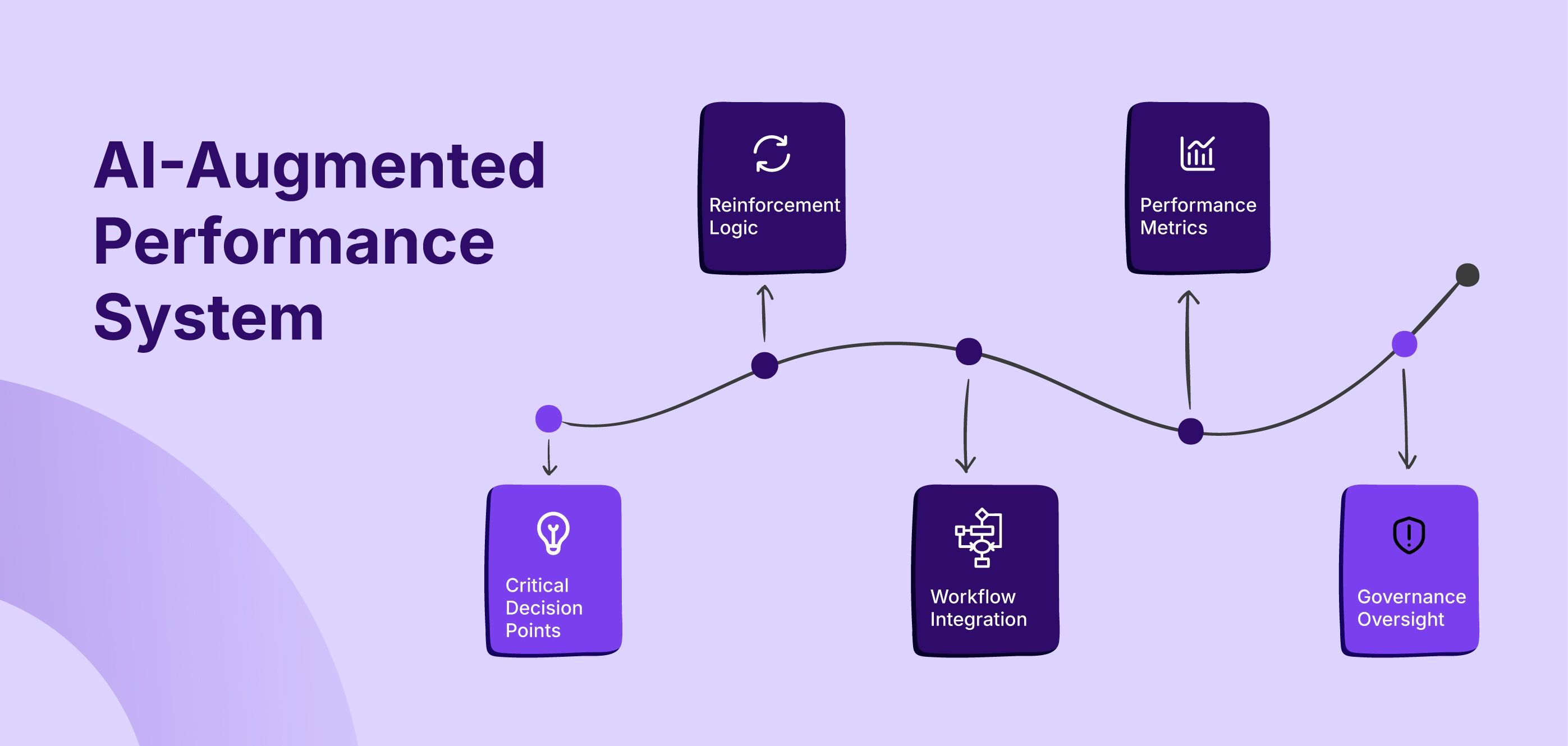
Designing an AI-Augmented Performance System
Reinforcement architecture requires disciplined design.
- First, map critical decision points with high error or risk concentration.
- Second, define reinforcement logic aligned to measurable KPIs.
- Third, integrate within workflow systems already in use.
- Fourth, establish metrics for error reduction, cycle time, and adoption velocity.
- Fifth, maintain governance oversight and audit traceability.
Data ownership, prompt validation, and reinforcement model review must be clearly assigned. Risk committees should understand how reinforcement logic influences decisions. Reinforcement systems should operate within broader capability ecosystems that connect analytics, skills, and performance systems.
 Organizations with low data maturity may struggle to deploy reinforcement effectively. Implementation readiness should be assessed before scale.
Five Key Takeaways for Enterprise Leaders
- AI in 2026 is shifting from content automation to embedded performance reinforcement.
- Behaviour adoption determines ROI more than exposure.
- High-risk workflows present the strongest reinforcement opportunities.
- Reinforcement enhances, but does not replace, core capability.
- Governance and audit clarity are essential design components.
What to Do Next
Begin with leadership alignment. Identify one high-risk workflow tied to measurable financial or compliance outcomes. Map decision points, define reinforcement logic, and assign ownership across L&D, IT, and risk functions. Pilot before scale. Validate governance, audit traceability, and measurable impact before expanding enterprise-wide.
Conclusion: Reinforcement, Not Information, Will Define 2026
AI investment is accelerating. Competitive differentiation will depend on how effectively organizations translate deployment into consistent decision quality. In 2026, enterprises that design reinforcement systems will move faster, reduce risk, and improve margin predictability. Those relying solely on content expansion will struggle to convert exposure into performance.
Reinforcement architecture is emerging as a strategic capability. The organizations that master it first will define the next phase of AI-enabled performance.
Sources
 Author
Shrinivas Karthik
Chief Product Officer 124 Articles Published
124 Articles Published
Shrinivas Karthik is a seasoned EdTech and product leader with deep expertise in digital learning architecture, learning experience design, and e‑learning strategy. As Chief Product Officer at Techademy, he drives the vision and execution of scalable, outcome‑centric learning solutions that align technology, pedagogy, and business value. With a strong focus on innovative product development and user engagement, Shrinivas partners with cross‑functional teams to enhance learning outcomes, improve adoption, and deliver impact across diverse enterprise environments. Known for blending strategic insight with practical execution, he plays a key role in shaping modern learning ecosystems that support enterprise capability building and digital transformation.
Share